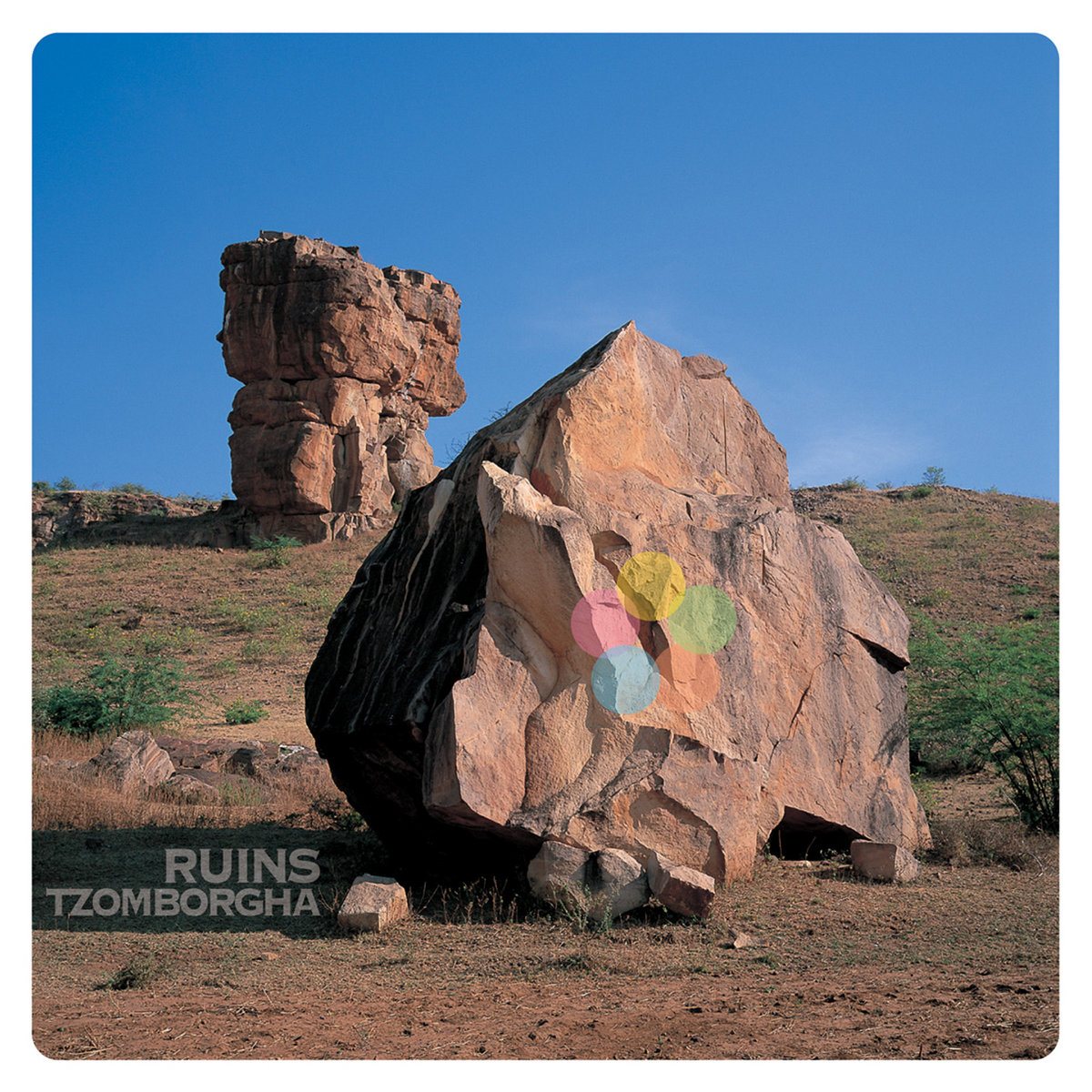
The first surprise of Tzomborgha is not how much noise two people can make. It is how precisely they place it. Ruins can pivot from a clipped unison figure to a lurching rhythm, a vocal burst or a bass line that seems to fold in on itself, then move again before the ear has finished processing the previous idea.
By 2002, drummer and vocalist Tatsuya Yoshida had been pursuing this problem for well over a decade. Ruins formed in Tokyo in 1985 and developed around an unusually severe limitation: drums, bass and voices, with no permanent guitarist to fill the middle. Bassists changed across the group’s history; for Tzomborgha, Yoshida’s partner was Hisashi Sasaki, whose effects-heavy bass could occupy several apparent roles at once.
The record was released by Ipecac Recordings on 11 November 2002. Its fifteen tracks run for just under 49 minutes, but duration is a poor measure of what happens inside them. Komnigriss barely reaches two minutes and still behaves like a suite. Skhanddraviza ricochets through tightly coordinated vocal and instrumental figures. The title track stretches to five and a half minutes, long enough for the duo’s density to become its own peculiar environment.
Ruins are frequently placed near zeuhl, progressive rock, noise and free improvisation, but Tzomborgha is interesting precisely because those labels keep failing to contain it. Yoshida’s drumming can be brutally direct and mathematically awkward in the same passage. Sasaki does not merely hold down the low end; his bass becomes riff, counterpoint, texture and interruption.
The humour is structural, too.
The album closes with a reversible Black Sabbath medley and a Mahavishnu Orchestra medley, collapsing canonical heavy rock and fusion into Ruins’ compressed grammar. They are not detached cover-band gestures. In this context, familiar material reveals how strange the duo’s own music already is: riffs become components to be rotated, accelerated and snapped into different shapes.
That instinct places Yoshida within a much wider experimental practice. His work extends beyond Ruins into projects including Koenji Hyakkei and Korekyojinn, while collaborations across his career connect him with improvisers including Fred Frith and Derek Bailey. Yet Tzomborgha depends on the intimacy of the duo format. Yoshida and Sasaki repeatedly execute abrupt figures together without needing a conventional pulse to explain where the floor is.
Complex music often advertises its complexity. Ruins do something more mischievous: they make virtuosity sound like a malfunction that has somehow learned perfect timing.