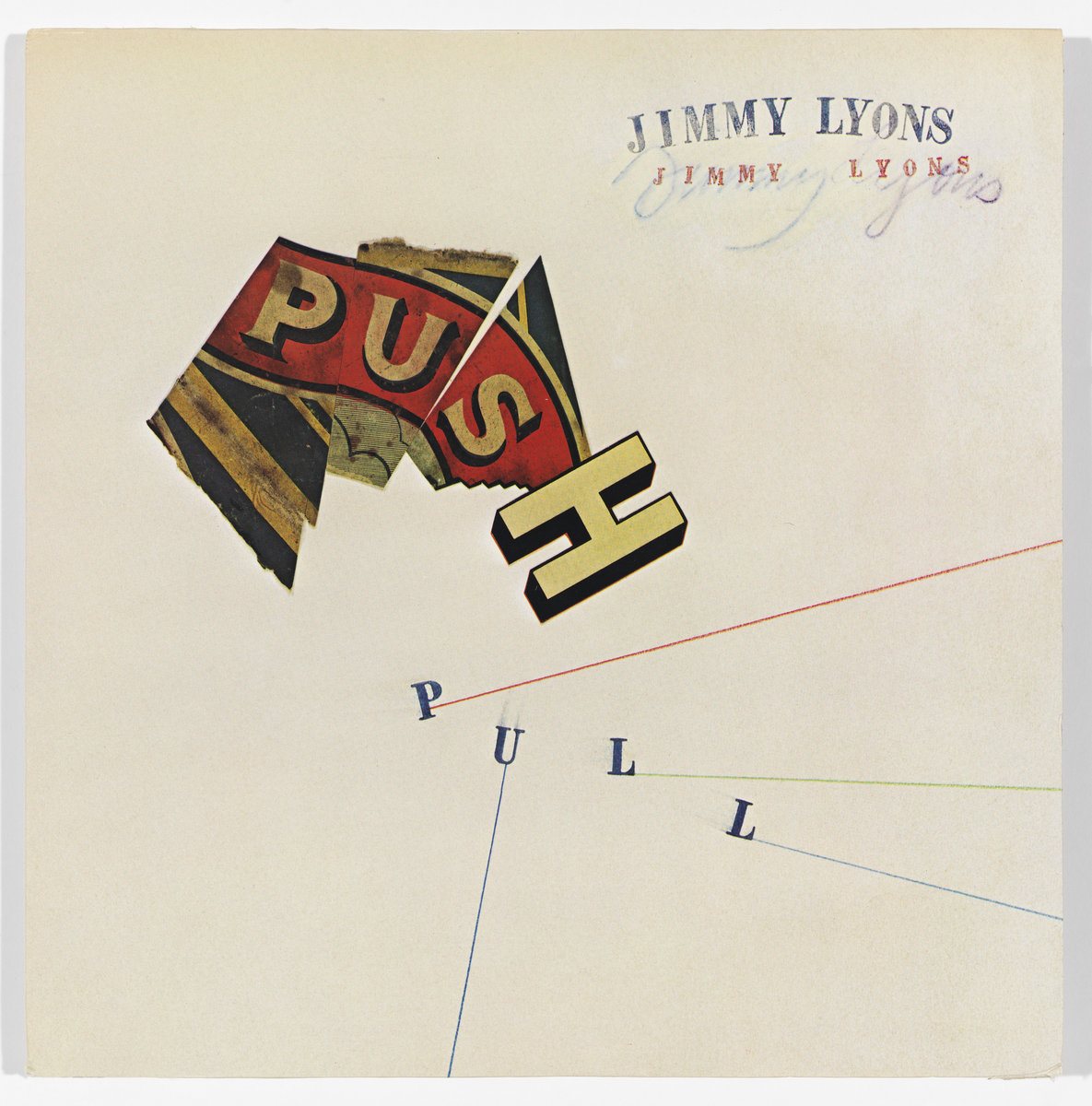
Jimmy Lyons spent the better part of eighteen years as the one musician who never left Cecil Taylor's band. The record that shows him most clearly, though, is the one where Taylor doesn't turn up.
Lyons grew up in Harlem and the Bronx, picked up his first alto in the mid-1940s under the eye of Buster Bailey, and came to the horn through Charlie Parker the way half his generation did. Korea and a stint at New York University came between; the Postal Service paid the bills while he built a sound that kept Parker's melodic logic intact inside music that had otherwise abandoned almost every other convention. He joined Taylor's unit in 1960 and stayed until his death in May 1986, the only constant in a band that reshuffled around him for a quarter of a century.
Push Pull was recorded live on 6 May 1978 at New York's Collective for Living Cinema and released the following year on the Swiss label Hat Hut. The room does as much of the record's work as the band does: a cavernous, slightly ragged acoustic not unlike the one Albert Ayler got out of Judson Church thirteen years earlier on Spirits Rejoice. Without Taylor's piano flooding every corner, Lyons's quintet stretches into something closer to bebop architecture, just built at ten times the scale — the opener, “Mary Mary”, runs past half an hour.
The quintet is Karen Borca on bassoon, Munner Bernard Fennell on cello, Hayes Burnett on bass and Roger Blank on drums. Borca is the record's real surprise. The bassoon barely exists in jazz outside her work; here it does the job of a second horn, its dry, reedy low end holding the middle ground between Burnett's pulse and Fennell's keening cello lines.
His alto keens. Her bassoon growls back.
Borca had met Lyons in 1974 while working as his assistant at Bennington College; they married, and she stayed in his working group for the rest of his life. That closeness shows in how unafraid the writing is of giving her room. Borca has said Lyons was the more rigid perfectionist of the two, more so, in her account, than Taylor himself, and the tightly wound themes on his Black Saint records, Give It Up chief among them, bear that out. On that 1985 session, Enrico Rava's trumpet and Paul Murphy's drums pick up the same trade of statement and retreat that runs through Push Pull, horns announcing themselves before folding back into the group.
Taylor's proximity has always made Lyons hard to hear on his own terms. Push Pull, stripped of the piano that usually swallows a room whole, is the plainest evidence yet of what he actually did inside it: hold a bebop line steady while everything around him pulled apart.