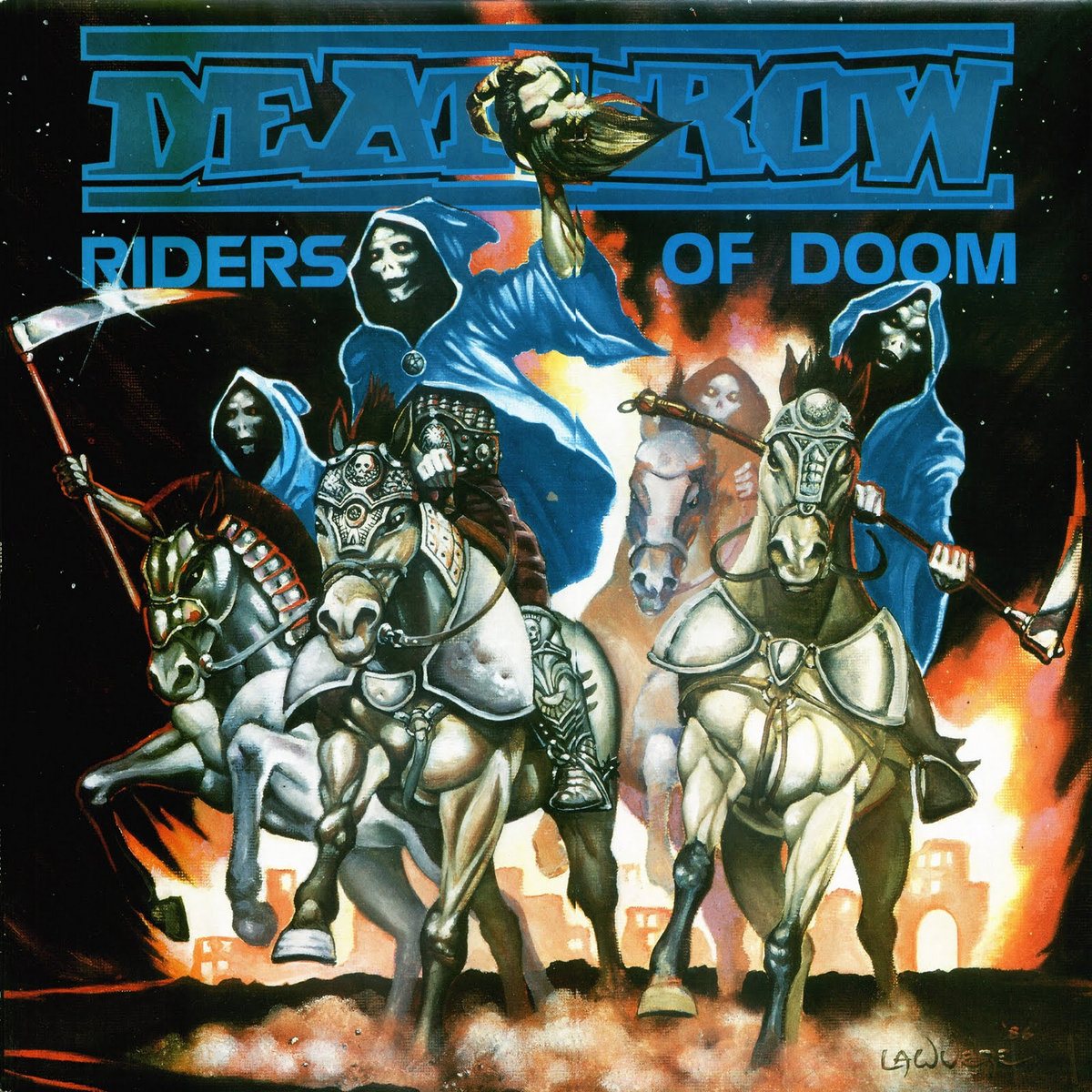
The interesting thing about Riders of Doom is not simply that Deathrow play fast. Plenty of German bands were learning to do that in 1986. It is the way their riffs keep developing after a more straightforward thrash group might have moved on: an extra turn, an awkward rhythmic kink, a melodic shape that briefly lifts the song out of the charge.
Deathrow began in Düsseldorf in 1984 under the name Samhain. The quartet that made the debut consisted of bassist and vocalist Milo Van Jaksic, guitarists Sven Flügge and Thomas Priebe, and drummer Markus Hahn. Early Samhain material survives inside the record's history, and that origin suits an album that often sounds caught between demo-room ferocity and a rapidly expanding musical vocabulary.
Recorded in 1986 at Studio Wahn in Bochum, Riders of Doom was produced by Ralph Hubert and André Chipalier. The original nine-song sequence runs from Winds of Death through Samhain, with Satan's Gift, Hell's Ascent and the title track establishing a language that is recognisably thrash but unusually restless. The album also acquired a confusing second identity: it appeared in the United States as Satan's Gift, a title the band has said was imposed without its permission.
That administrative messiness almost fits the music. Deathrow belong to the same German thrash eruption that produced Kreator, Sodom and Destruction, yet Riders of Doom is less interested in reducing everything to pure velocity. Flügge and Priebe pile riffs into songs that stretch beyond the shortest attack, while Jaksic's bass and Hahn's drumming keep the structures from becoming academic exercises.
The technical element is still embryonic here. That is precisely what makes the record compelling. Its complexity has not yet hardened into a genre code. A song can lurch from primitive pounding into a more elaborate guitar passage without announcing that a different kind of metal has begun. The band are finding sophistication inside aggression rather than replacing one with the other.
Deathrow sharpened that instinct on Raging Steel in 1987, and guitarist Uwe Osterlehner's later arrival helped push the group further towards progressive and technical writing. Heard from 2026, however, the debut should not be treated merely as a sketch for what followed. Its uncertainty is productive.
Riders of Doom captures a moment before thrash's internal categories became easy shorthand. Deathrow sound young enough to attack every passage and curious enough to complicate it. The result is raw German metal with too many ideas to stay primitive, and too much momentum to become cerebral.