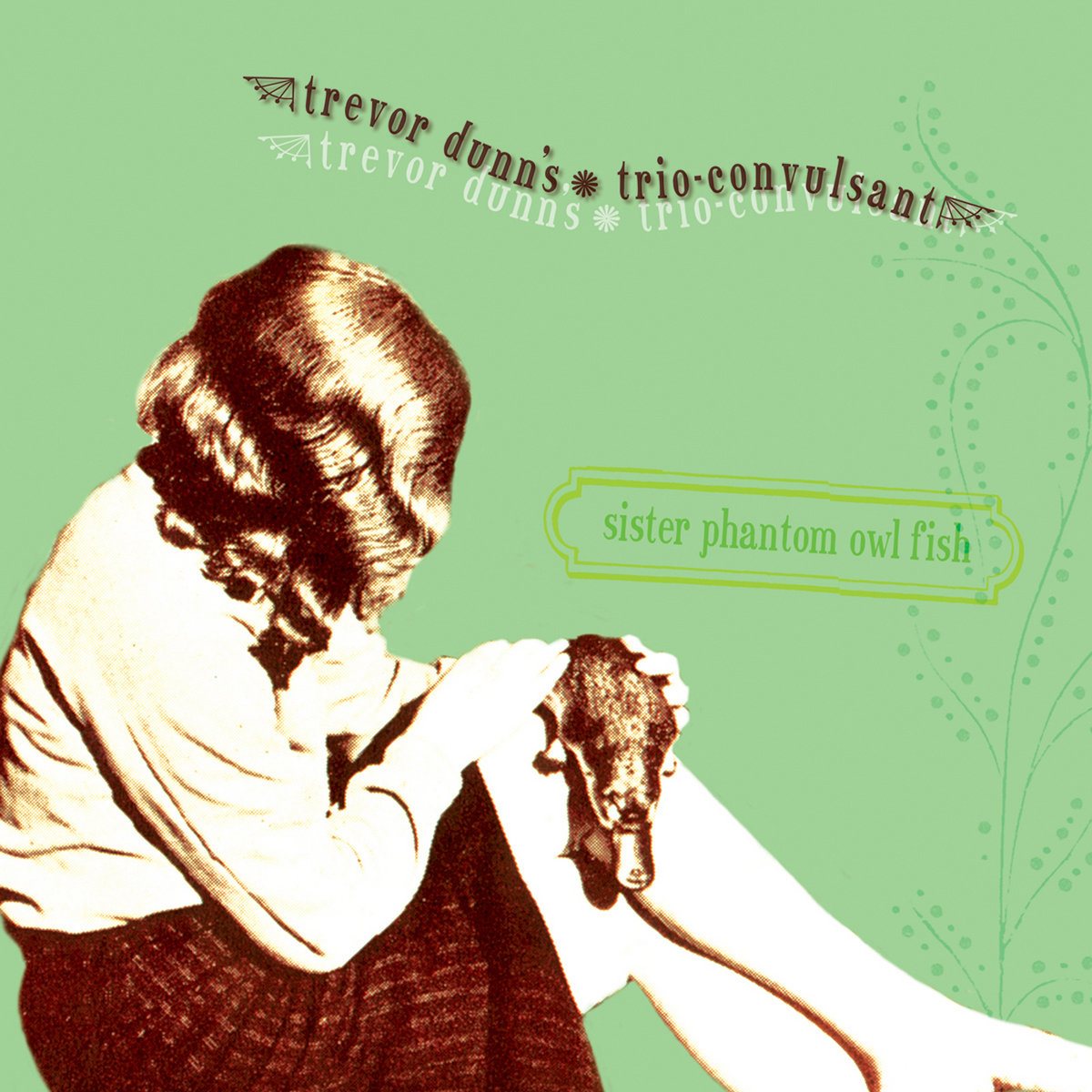
Trevor Dunn’s music has rarely treated genre as a border. On Sister Phantom Owl Fish, the more interesting question is what happens when different musical instincts are forced into the same room and none is asked to behave politely.
Released by Ipecac Recordings in 2004, the album is the second record by Dunn’s Trio-Convulsant and the first with guitarist Mary Halvorson and drummer Ches Smith. Dunn leads from bass, but the trio is designed to resist a clean centre. Written counterpoint sits beside free improvisation. Power chords rub against atonal lines. Rhythms can swing, then deliberately refuse to.
Dunn’s background helps explain why the collisions feel structural rather than decorative. He began playing electric bass at 13 and later studied classical double bass. He also co-founded Mr. Bungle as a teenager and became part of Fantômas. Trio-Convulsant gives him a setting where those histories do not have to be reconciled.
Halvorson is crucial to the record’s identity. Her guitar can be abrasive and blunt, but also oddly elastic, slipping between jagged chord shapes and lines that seem to bend around the beat. Smith responds with drumming that is equally alert to composition and disruption. Dunn’s bass is the connective tissue, though “connective” undersells how often he destabilises the music from below.
The album works because the trio never smooths out its contradictions.
That makes Sister Phantom Owl Fish less a fusion record than a study in controlled incompatibility. “Me Susurra Un Secreto” makes room for space without becoming calm; elsewhere, tightly written passages can feel as volatile as the improvised sections around them. The point is not virtuosity for its own sake, even when the playing is exacting. It is the use of virtuosity to keep several musical logics active at once.
Dunn returned to the Trio-Convulsant name in 2022 for Séances, expanding the core group of Halvorson and Smith with Carla Kihlstedt, Oscar Noriega, Mariel Roberts and Anna Webber. That later ensemble makes explicit something already present in Sister Phantom Owl Fish: Dunn thinks like a composer who happens to love the physical risk of a rock trio.
The 2004 record remains a compact statement of that approach. It does not ask jazz to become heavier or metal to become more sophisticated. It simply puts both under enough pressure that the labels stop being useful.