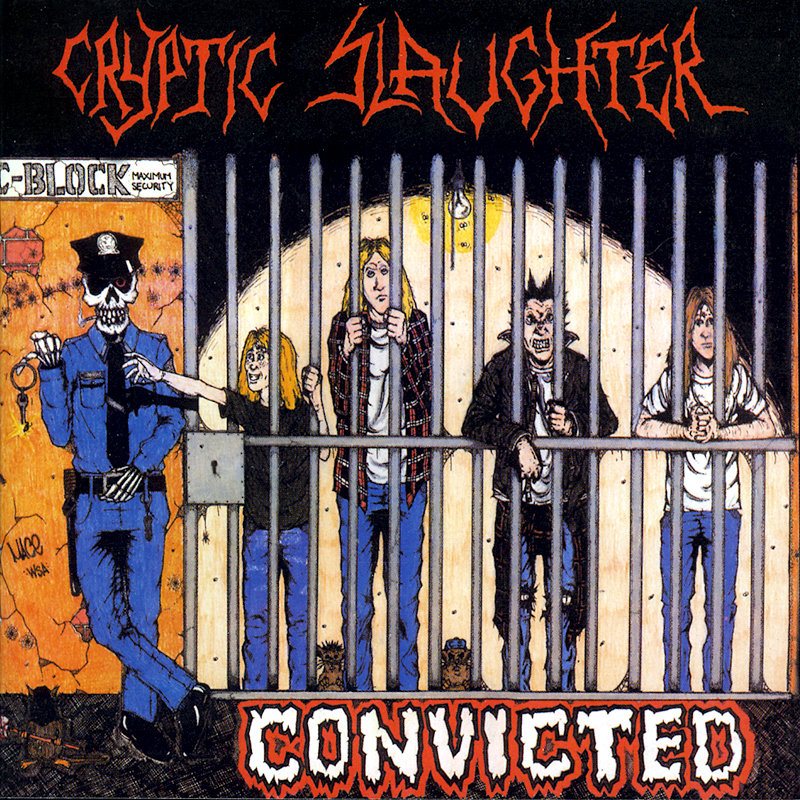
Scott Peterson was still a teenager when his drumming on Convicted made speed feel less like a tempo than a structural problem. Cryptic Slaughter's 1986 debut keeps asking how quickly a hardcore song can move before its riffs, politics and hooks collapse into noise. The answer, across 14 tracks, is: faster than seems sensible.
The Santa Monica band began in 1984 with guitarist Les Evans, drummer Peterson and Adam Scott, teenagers who knew one another through youth soccer. Vocalist Bill Crooks soon joined, and bassist Rob Nicholson completed the line-up heard on Convicted. Before the album came the 1985 Life in Grave demo, circulated through the tape-trading network that functioned as underground music's pre-internet nervous system.
That route matters because Cryptic Slaughter's music is built for transmission. Songs hit their point quickly. Peterson's drumming accelerates beneath Evans's guitar while Crooks delivers lyrics as compressed bursts of political frustration. Nicholson gives the low end enough definition that the record rarely becomes an undifferentiated blur. Recorded at Track Records in North Hollywood and engineered by Bill Metoyer, Convicted was released through Death/Metal Blade in 1986.
The word crossover can make this period sound tidier than it was. On songs such as M.A.D., Rest in Pain, Lowlife and Sudden Death, punk economy and metal technique are not peacefully blended; they compete. Half-time passages briefly open the floor before another sprint begins. Solos appear as flashes rather than destinations. The album's aggression comes partly from that refusal to settle.
There is a political equivalent in Crooks's writing. Cryptic Slaughter belong to a generation of American hardcore bands suspicious of authority and militarism, but the metallic attack changes the scale of the complaint. The songs do not read like detached commentary. They sound trapped inside the systems they are attacking, which gives the record its claustrophobic urgency.
The band followed Convicted with Money Talks in 1987 and Stream of Consciousness in 1988. Their original run was short, yet the debut's extremity left a long shadow over crossover, thrashcore and the faster forms developing around them.
What remains striking about Convicted is how little distance it places between youthful impulse and finished record. Its velocity never becomes polish; the songs retain the unnerving quality of young musicians discovering that their physical limits can become compositional tools.
Speed is the obvious headline. The more interesting achievement is that, underneath it, you can still hear four distinct people pushing.