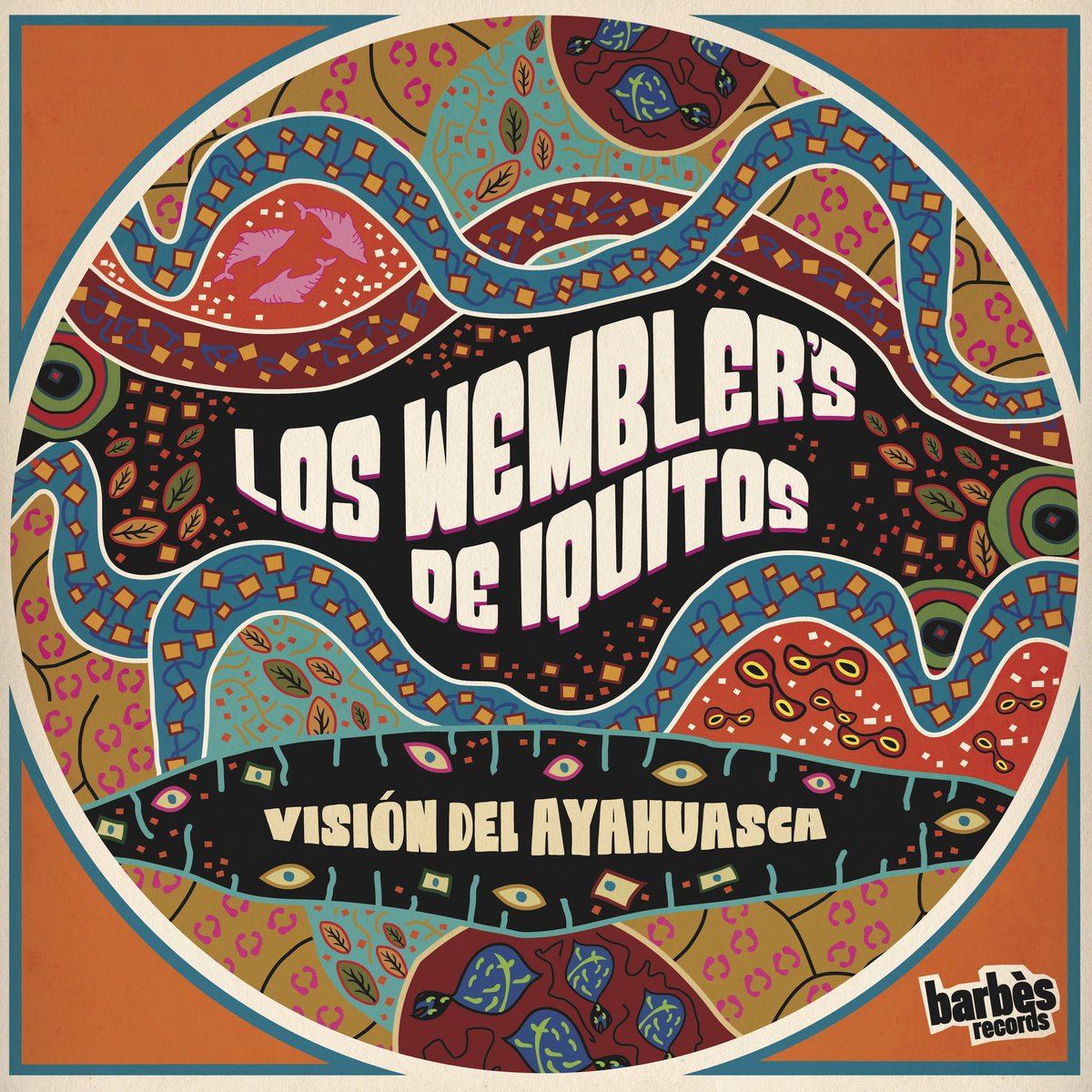
The guitar in Los Wembler's de Iquitos does not so much decorate a rhythm as stalk it. Thin, bright and slightly feral, it curls around percussion and organ with the restless motion that has defined the Sánchez family's music since the late 1960s.
That makes Visión del Ayahuasca, released in 2019 on Barbès Records, a particularly satisfying return. It was the group's first studio album in more than 35 years, yet its ten songs avoid the embalmed feeling that often comes with comeback records. The playing is loose enough to breathe and disciplined enough to keep the cumbia pulse doing its essential work.
Los Wembler's began in Iquitos in 1968, when Salomón Sánchez formed a band with his five sons. The city's geography mattered. Iquitos sits deep in the Peruvian Amazon, and the music reaching the family through AM radio carried signals from Colombia, Ecuador, Brazil, Venezuela, Cuba, Mexico and the United States. The brothers folded those transmissions into local musical life: Colombian cumbia and Brazilian carimbó alongside psychedelic and surf-rock guitar, Afro-Cuban percussion and Farfisa organ.
The result became part of the foundation of cumbia amazónica. Songs including Sonido Amazónico and La Danza del Petrolero travelled far beyond Iquitos, while the band recorded at a remarkable pace during the 1970s. After their father's death, recording and international touring eventually stopped, although the brothers continued playing locally.
The wider world caught up slowly. Los Wembler's returned to Lima in 2011 after roughly a quarter-century away from the capital, appeared at the Smithsonian Folklife Festival in Washington in 2015, and signed with Barbès Records before releasing the Ikaro del Amor EP in 2017. By the time Visión del Ayahuasca arrived, their old records had become reference points for musicians interested in the overlap between tropical rhythm, electric guitar and psychedelia.
But the album is more compelling when heard without the museum glass. Lamento Selvático stretches past five minutes, giving the groove room to coil; the title track follows with another long, hypnotic passage. Elsewhere, Mi Caprichito, Cosa Muy Rica and Los Wembler's Para El Mundo keep the arrangements concise and dance-facing. The guitars remain sharp rather than heavy, while percussion supplies momentum without crowding the melodies.
That balance is the band's signature: music shaped by a specific place but built from signals crossing borders. Visión del Ayahuasca does not recreate the 1970s. It shows that Los Wembler's never needed to.