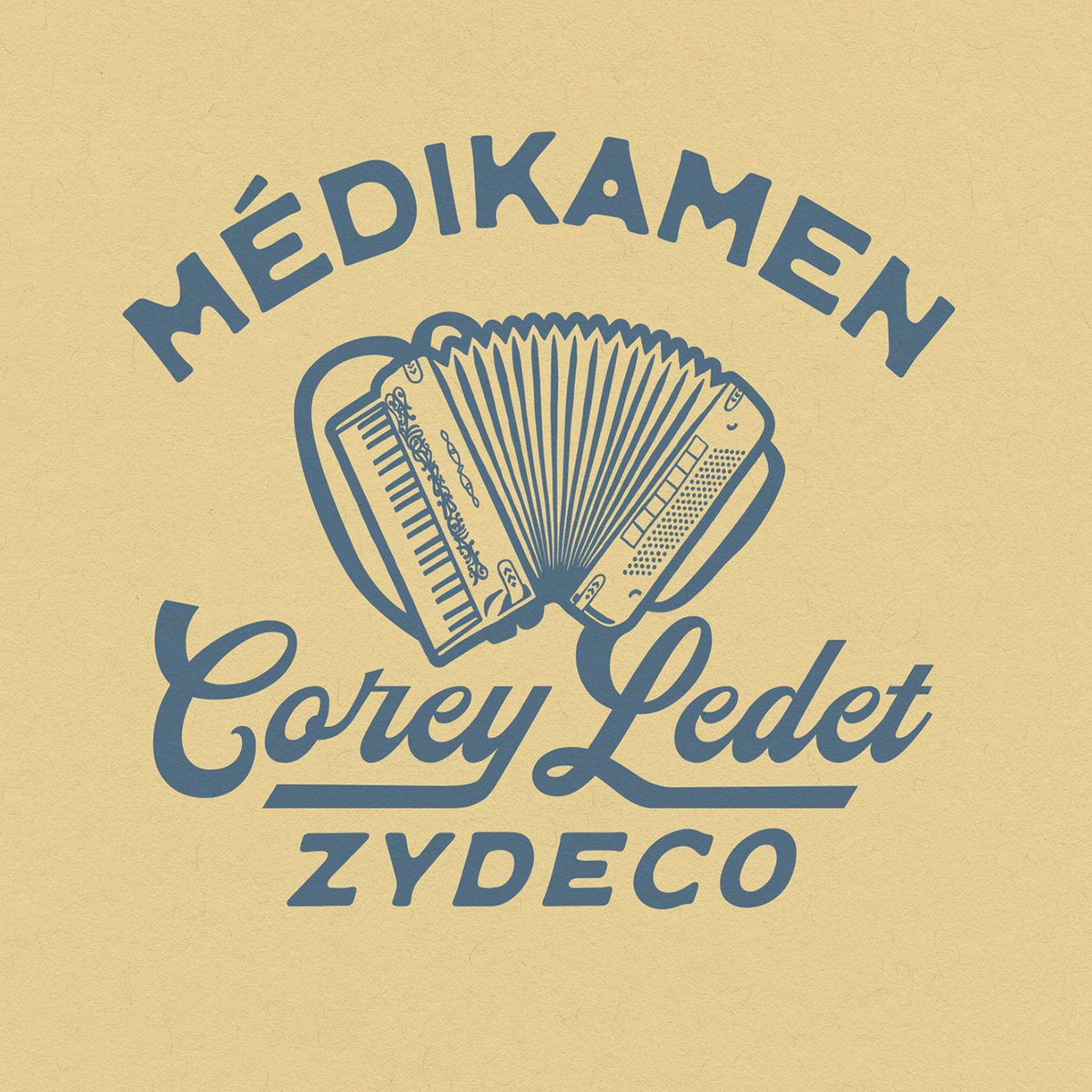
The most radical thing on Corey Ledet’s Médikamen is not an accordion technique. It is the language in his mouth. Across 12 songs, Ledet sings entirely in Kouri-Vini, or Louisiana Creole, making a record about cultural continuity without reducing that culture to an archival exercise.
Released on 25 August 2023, Médikamen is Ledet’s 15th album and the first of his zydeco records written and performed completely in the heritage language of his family. He grew up in Houston, while his family comes from Parks in St Martin Parish, Louisiana. Learning Kouri-Vini became a route back towards relatives and a community history that Americanisation had steadily pushed from everyday use.
The music refuses solemnity. Ledet is an accordionist formed by zydeco’s appetite for movement, and the record treats language as something for a dance floor rather than a classroom. His command of several accordion types gives him a broad palette: the one-row button accordion connects to older Creole practice; the piano accordion carries the imprint of Clifton Chenier; the three-row button instrument points towards the neighbouring sounds of Mexican and Tejano music.
That breadth is inherited as much as studied. Ledet’s grandfather Buchanan Ledet played drums with Clifton Chenier and Rockin’ Dopsie and is associated with the double-clutch bass-drum pattern. Corey’s own career has similarly resisted narrow genre borders. Before Médikamen, he had already received two Grammy nominations in the regional-roots field, including one for 2021’s Corey Ledet Zydeco.
On Médikamen, history becomes social rather than ceremonial.
Ledet co-produced the album with Louis Michot and recorded at Dockside Studio in Maurice, Louisiana. The band includes Lee Allen Zeno on bass and backing vocals, Lucien Hayes and Julian Primeaux on guitars, Cecil Green on Hammond B3 and Fender Rhodes, and Je’an-Paul Jolivette on drums. Guests widen the frame: Anders Osborne appears on Kofè t’fé ça, while New Orleans trumpeter Kermit Ruffins joins the title track.
Those names matter because Ledet’s idea of Creole music is porous. Jazz, blues and zydeco are not presented as separate family trees; they meet in a regional history where musicians, rhythms and communities have long overlapped. Kouri-Vini gives the album its organising principle, but the playing keeps it physical.
Médikamen therefore works on two clocks. One runs backwards through family memory, Chenier and older Creole practice. The other runs in the present tense: a musician choosing to make an endangered language useful, singable and loud enough for the next dance.