At around midnight on 2 May 1951, twenty-four performers filed into a room at Columbia University, took hold of twelve radios, and did exactly what the score told them: one turning the volume, the other hunting the dial. Imaginary Landscape No. 4 hung on two things nobody in the room could control, the throw of coins from the I Ching that had shaped Cage's score, and whatever the New York airwaves happened to be carrying at that particular late hour. Most of the city's stations had already signed off, so what came through was static, fragments of a ball game, news out of Korea, and, at one point, a stretch of Mozart's violin concerto that drew ironic applause from the audience. Cage himself thought it had fallen flat, calling it afterwards "certainly not a rabble-rouser."
He was wrong about that, as it turned out.
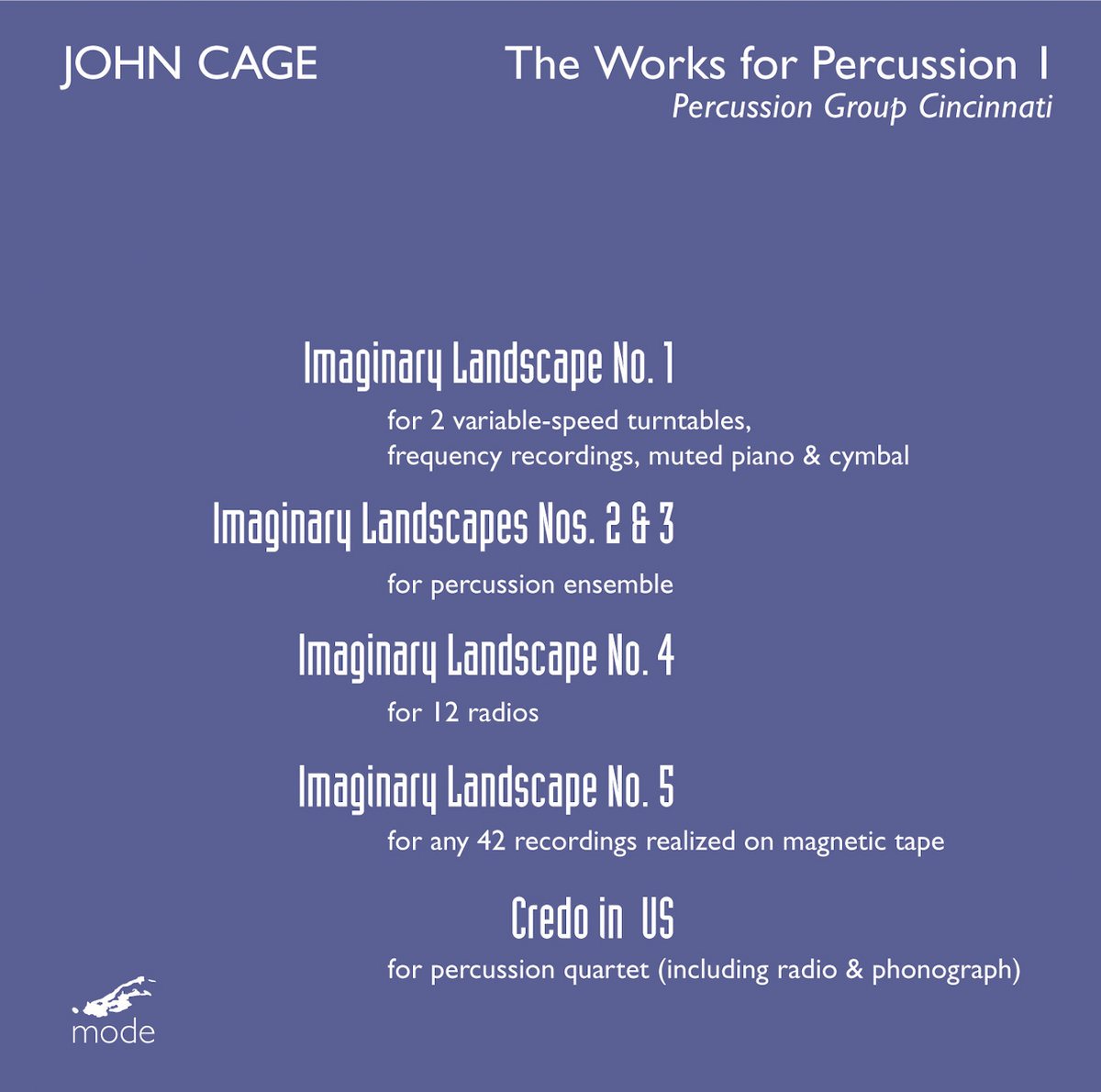
Mode Records' Complete John Cage Edition, now in its fifth decade of releases, reaches volume 43 with Works for Percussion 1, a set built around Percussion Group Cincinnati and the CCM Percussion Ensemble under conductor James Culley. The disc runs to nine tracks: Imaginary Landscape Nos. 1 through 3 alongside two takes each of Nos. 4 and 5, and two versions of Credo in Us, the 1942 piece that pits massed percussion against a phonograph spinning whatever record a performer chooses, in this case a passage of Shostakovich's Fifth Symphony on one recording, snatches of Beethoven, Tchaikovsky, Wagner and von Suppe on the other. It's a small but telling detail: even a "fixed" Cage score changes its identity depending on what happens to be on the turntable that day.
What makes this particular recording worth the fuss is method rather than repertoire. For Nos. 1 and 2, the performers tracked down Cage's specified 78-rpm test-tone discs and ran them through variable-speed turntables of the kind the composer had in mind, making this the first modern recording to use that original equipment rather than approximate it. No. 4 runs on something no turntable can supply: live radio, picked up during the sessions themselves, a terrorism bulletin, a stray country song, a few bars of the Beatles' "Let It Be" cutting through the static. Between the two methods, the record makes the same point twice over: a piece built on chance keeps generating new, unrepeatable versions of itself, whether the apparatus is a restored 1951 turntable or whatever happens to be on the airwaves that night.
This is early Cage, years before 4'33" or the collaborations with Merce Cunningham and David Tudor that would define his reputation as new music's great disappearer of ego, but the instinct is already fully formed. Radios, turntables, coin tosses: Cage kept handing control of his own compositions to whatever happened to be passing through the room, and percussion, unpitched, indifferent to melody, was the ideal instrument for a composer trying to get out of his own way.