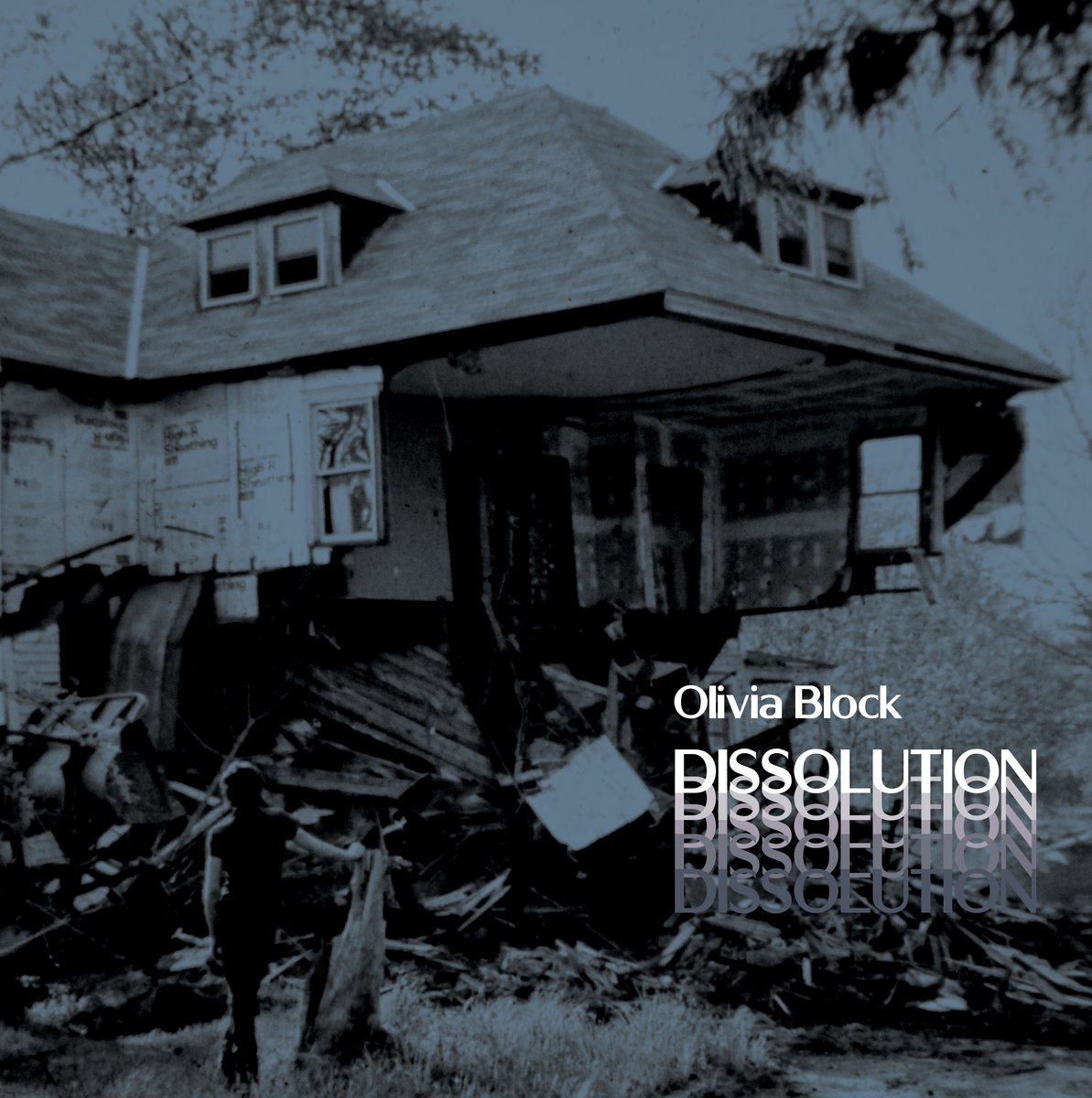
Some of the tape hiss on Dissolution comes from couples' therapy sessions.
Olivia Block recorded them on microcassette during her own divorce, then folded them into a two-side, thirty-one-minute piece alongside shortwave radio, municipal broadcast chatter and whatever else she had lying around on found tape. Voices talk over one another, drop out, and are swallowed by static before a sentence finishes. Block has been careful to say the record is not really about the divorce. It is about what happens to meaning once it has to travel through a wire, a signal or another person, and the marriage is simply the closest example she had to hand.
That distinction matters, because Block has spent two decades treating communication technology as a subject rather than a tool.
She is a Chicago-based composer who teaches sound at the School of the Art Institute and at Northwestern, and her catalogue, records like Pure Gaze, Heave To and Karren, has moved between orchestral and chamber scores, film sound design, and pieces built from amplified breath, prepared piano, broken glass, and field recordings and archival tape sourced from the 1950s through the 1990s. She is drawn to what she calls "webs of significance", the systems, official and domestic, that carry information and inevitably let some of it fall apart along the way. Shortwave radio is an obvious subject for that idea. A marriage, it turns out, is another.
Dissolution appeared on Block's own imprint, Glistening Examples, in November 2016. Both tracks share the title "Dissolution," the first running seventeen minutes, the second just over fourteen minutes, and neither resolves so much as thins out. Block had performed an early version at ISSUE Project Room in Brooklyn in September 2013, alongside the composer Pauline Oliveros, before the marriage underneath the finished record had ended, and the piece only found its final shape once she started layering the microcassettes over the radio material rather than choosing between them.
The result asks more of a listener than most records built from static.
There is no narrator, no clear foreground voice to follow, only overlapping evidence of people trying and failing to be understood by the person closest to them and by strangers on a frequency thousands of miles away. Placed against other radio-art records that treat interference as pure texture, Dissolution insists on the opposite: that every burst of noise once carried someone's attempt to be heard, and that the failure to get through, not the noise itself, is the more universal condition.