Morton Feldman once stood in front of a new painting by his closest friend, Philip Guston, and said only, “Well, let me look at it for another minute.”
Guston had abandoned the loose abstraction that had bound the two men together since 1951 for lumpen, cartoonish figures — hooded men, boots, cigarette ends — and Feldman never really forgave him. The two barely spoke again.
They had met at a gathering organised by John Cage in early 1951 and fell into the same room at the Cedar Tavern as Rothko, Kline and de Kooning, painters whose scale and nerve Feldman wanted for music rather than canvas.
Guston died in 1980, still estranged from him, and asked on his deathbed that Feldman say Kaddish.
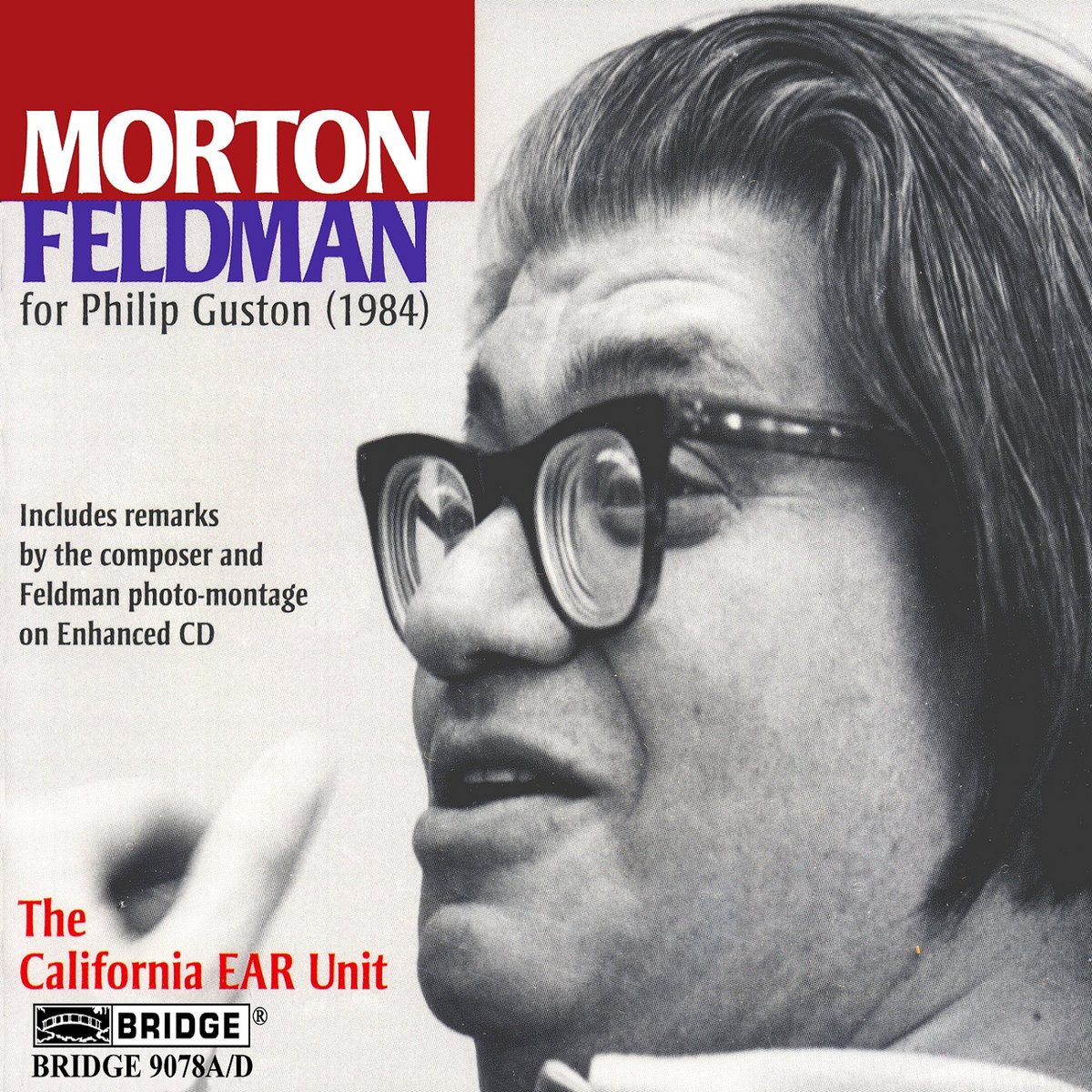
Four years later Feldman answered with for Philip Guston, a trio for flute, vibraphone and piano that runs past four hours and says almost nothing outright while refusing to stop saying it. The whole piece grows from four notes — C, A flat, G and E flat — turned over, thinned and thickened for the length of a working day, more contrapuntal and knotted than the single long line of his String Quartet No. 2, finished the year before.
Reich and Glass took Feldman's idea of a single, unforced sound and built engines out of it — pulse, phase, repetition as motor. Feldman never wanted an engine. He wanted the ear to notice a chord arrive, hang and dissolve without any of the parts admitting they were connected, so that four hours in, nothing has technically repeated and nothing feels new either.
Bridge Records' account of it, played by the California EAR Unit and spread across four discs under catalogue number 9078, is the closest thing the piece has to a reference recording: unhurried and exact, with none of the routine incident that would kill this material stone dead. One disc in the set carries a spoken introduction from Feldman himself, recorded before his death in 1987, alongside a photo montage of the composer.
Feldman spent his life trying to write music with the physical presence of a Guston canvas or a Rothko chapel wall, something you stand in front of rather than listen through, and this is the piece where the size of the gesture matches the size of the loss it came from. Arriving in his own centenary year, it is a reminder that his longest works were never stunts of duration for its own sake, but the only scale his grief, and his friendships, seemed to fit — one long chord, held long enough to become a kind of forgiveness he never got to offer while Guston was alive.