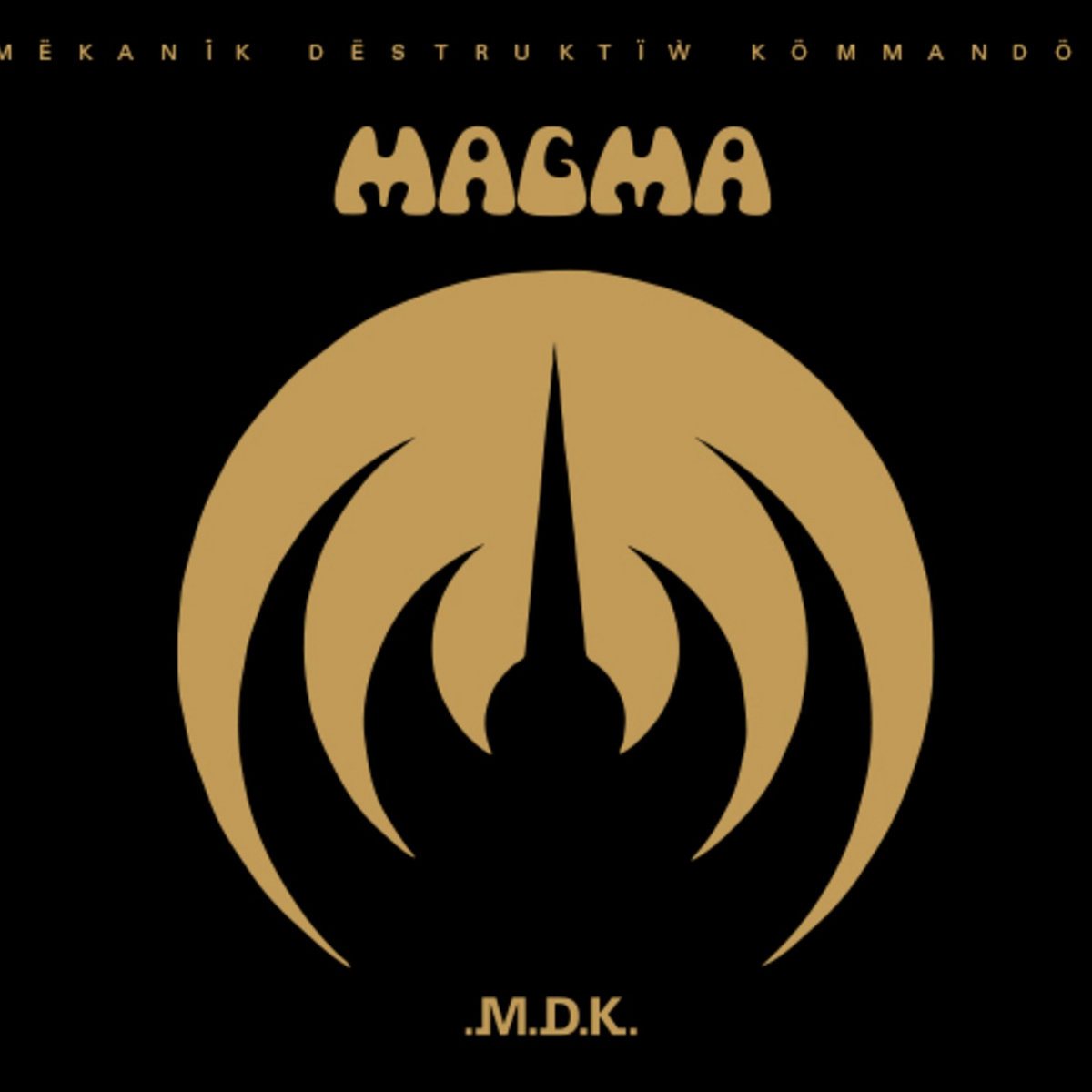
Magma do not so much begin a song as establish a law of gravity. On Mëkanïk Dëstruktïw Kömmandöh, Christian Vander’s drums keep tightening the frame while bass, piano and voices gather around them, until the music feels less performed than enforced.
Released in 1973, the album is a single long composition divided into seven movements. Vander had already built Magma around an unusual proposition: a band could invent not only its own sound but its own language and mythology. Kobaïan, the language used across the group’s work, strips away the easy semantic foothold of rock lyrics. The voice becomes rhythm, texture and command.
That matters especially here. Klaus Blasquiz and Vander lead a vocal architecture reinforced by a female choir that includes Stella Vander. The singing moves between chant, declamation and near-operatic mass, while the instrumental group works underneath with extraordinary physical insistence. The result has the scale of choral music without losing the pressure of a rhythm section.
The crucial new force is Jannick Top. His arrival on bass gives Vander a partner capable of making repetition feel architectural rather than static. Their low-end patterns do not decorate the composition; they determine its terrain. Piano figures jab at the edges, brass colours the larger gestures, and the voices repeatedly turn a motif into something communal and severe.
This is where the term Zeuhl, now inseparable from Magma, becomes useful. It describes less a conventional genre than a particular sense of propulsion: jazz-trained musicianship, rock volume, choral writing and repetition organised around Vander’s highly specific musical universe. Plenty of progressive rock expands outward through virtuosity. Magma compress inward, returning to phrases until they acquire the weight of ritual.
The record was made at the Manor in Oxford, with Vander and Blasquiz surviving from the preceding line-up and a substantially rebuilt ensemble around them. That change is audible. Earlier Magma already contains the vocabulary, but Mëkanïk Dëstruktïw Kömmandöh concentrates it into one sustained argument.
More than five decades on, its strangest quality is not the invented language or the mythology. It is how disciplined the whole thing sounds. The drama comes from accumulation: another voice entering, another bass figure locking into place, another turn of the rhythmic screw.
Magma made a world, but the reason that world still holds is simpler. Every part of it moves to Vander’s pulse.