A player locks onto a shortwave signal, some scrap of a broadcast bouncing in from thousands of miles away, and has one job before anything else: copy it. Not sample it, not process it, actually imitate it on their instrument, its pitch, its rhythm, its grain. Only once that's done are they allowed to start pushing it away from the original, nudging duration, register, dynamics and density up or down according to a set of plus and minus signs on the page. That's the mechanism at the centre of Karlheinz Stockhausen's Kurzwellen, composed in 1968 and still one of the strangest scores anyone has handed to a working ensemble.
Stockhausen had a reason for choosing shortwave over any other band.
Where John Cage, working with radios a decade and a half earlier, wanted his performers indifferent to whatever came out of the speaker, Stockhausen wanted the opposite: total engagement, an active conversation between player and transmission. Shortwave, with its capacity to pull in signals from the other side of the planet, let him frame the piece as something close to a utopian gesture, musicians in one room improvising in real time with the whole world's airwaves, working towards what he called, without much modesty, a harmony of the spheres achieved through technology and electricity.
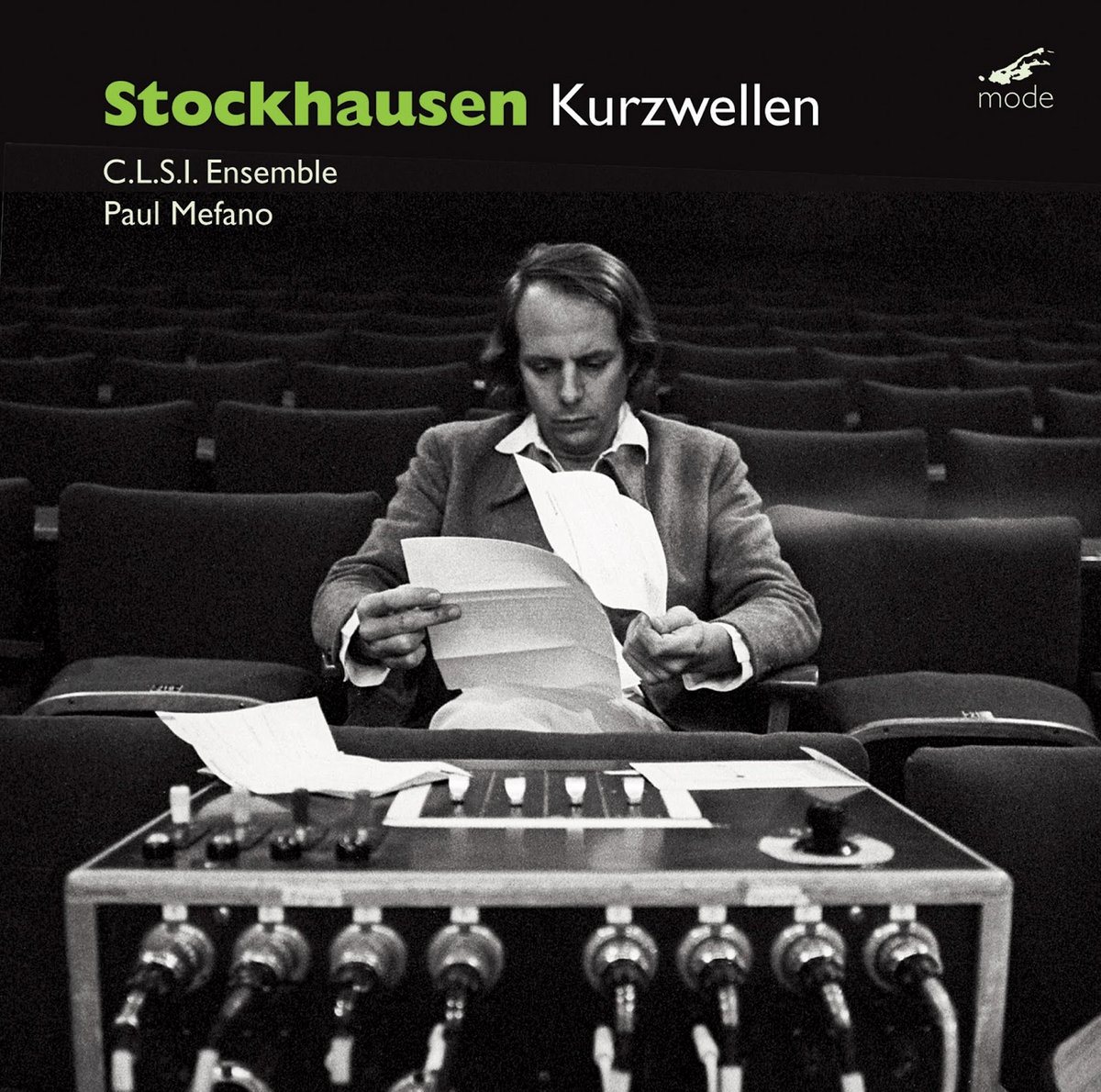
Mode Records' recording, made by the C.L.S.I. Ensemble, Circle for the Liberation of Sound and Image, and recorded in January 2012 at GRM Studios in Paris under the conductor Paul Méfano, updates the original instrumentation for four instruments, four shortwave sets, six computers and a conductor. Each player works with a dedicated radio operator, hunting the dial in tandem so the process can keep moving without a dead signal stalling the system. Across thirty-one tracks, organised into four numbered systems, duos and trios peel off from the radio material and back again, the electronium's onetime job now handled by laptops.
What survives the upgrade is the piece's oddest trick: shortwave itself hasn't really changed. The crackle, the Morse stutter, the ghost voices fading in and out of a signal dragged across a continent, it sounds roughly as it sounded in 1968, which means a process built on whatever the dial happens to catch still plays like a genuine time capsule rather than a museum reconstruction. Few scores this systematic leave so much to the world outside the room.
It's a demanding listen on record, more interesting as documentation of an idea in motion than as something to put on for pleasure, closer to transcribed research than repertoire. But that's true of a fair amount of Stockhausen's output from this period, when he was less interested in finished objects than in processes performers could inhabit differently every time, and Kurzwellen remains one of the clearest demonstrations of what that actually sounds like in practice.