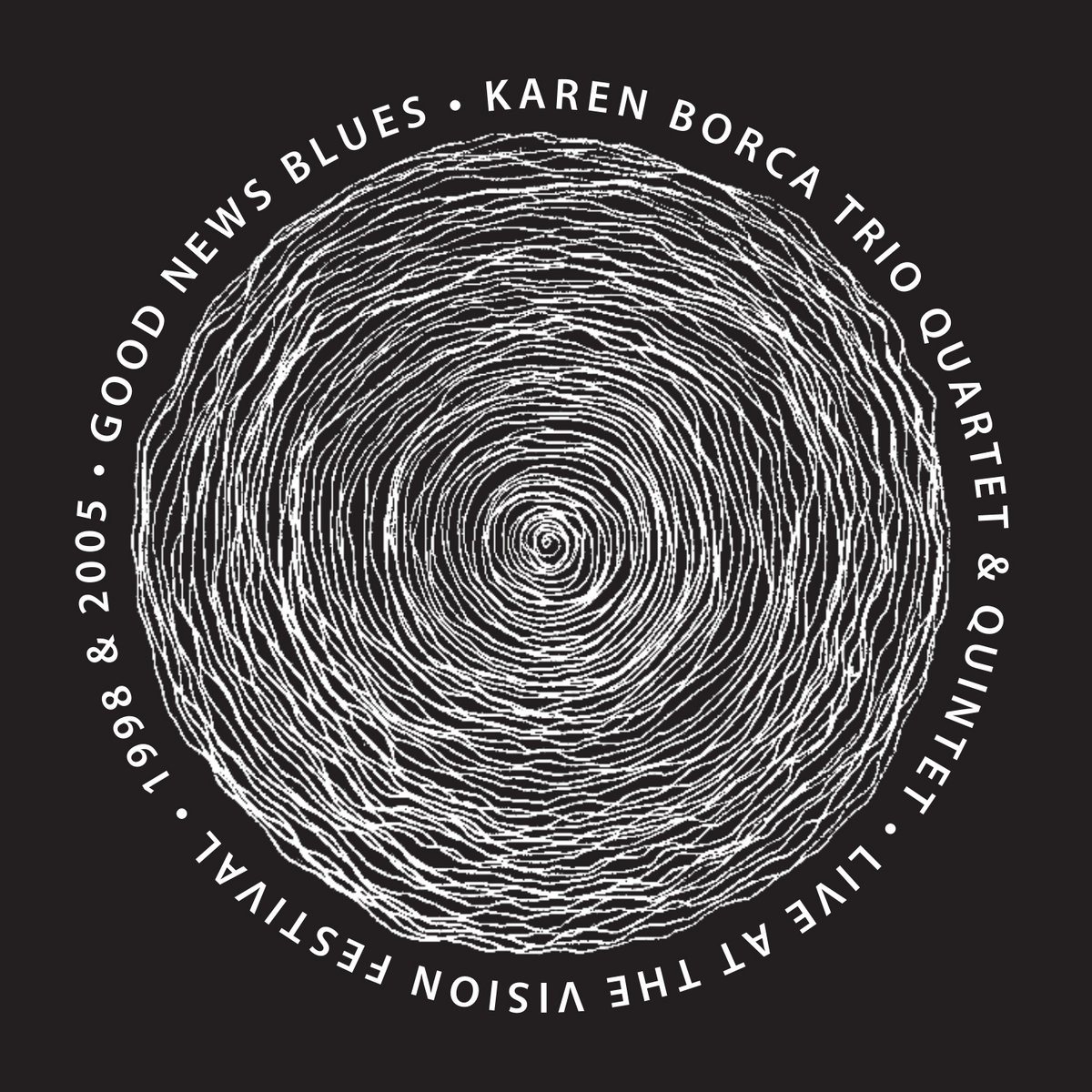
Karen Borca spent the better part of three decades standing just behind other people's names on other people's records. Good News Blues, released two years ago on the Lithuanian label NoBusiness, is the first one with hers alone on the cover.
The music itself is older still. It's drawn from two Vision Festival sets at New York's Angel Orensanz Center, one from 25 May 1998 and one from 19 June 2005, both sat on tape for years before anyone thought to put them out as a leader date.
Borca came to the bassoon by way of Green Bay, Wisconsin, where she was born in 1948, and the University of Wisconsin, where she took a music degree in 1971 studying under John Barrows and Arthur Weisberg. Cecil Taylor was teaching there at the time, and she fell into his orbit early, later assisting him at Antioch College and eventually appearing alongside him on record. In 1974 she took a job as saxophonist Jimmy Lyons's assistant at Bennington College; the two married, and she stayed in his band until his death in 1986, then kept working the same circuit with Taylor himself, with Bill Dixon's orchestras, and with Alan Silva's.
Across all of that, the bassoon was doing something it almost never does in jazz: standing in for a second horn inside crowded, difficult ensembles, heard but rarely out front.
The title track flips that. Recorded as a trio with William Parker on bass and Paul Murphy, her old collaborator from the Lyons years, on drums, it gives Borca nine unbroken minutes with nothing else competing for the room. Her lines double back on themselves and climb into the instrument's reediest upper register, somewhere most bassoonists never go looking. Two more pieces from the same 1998 set, “Something” and “Cambiar”, expand to a quartet — Parker still on bass, Susie Ibarra taking over the drums, and altoist Rob Brown joining the front line — trading the low-end dialogue of the opener for something closer to a conversation among equals.
The fourth piece jumps forward to 2005 and swells to a quintet, Brown returning alongside two bassists, Reggie Workman and Todd Nicholson, and drummer Newman Taylor-Baker, the doubled low end giving Borca a thicker floor to push against.
The tapes were remastered in Vilnius for this release, and the liner notes come from the critic Ed Hazell, but none of that changes what actually happened on those two nights nearly three decades apart. What it does is correct the record, literally: an instrument that spent fifty years holding other people's music together finally gets billed for doing it.