Tom Chiu says that playing Morton Feldman's Second String Quartet is less an athletic ordeal than a mental one: keeping focus across six hours of near-silence is harder than the ache in the bowing arm.
The Kronos Quartet learned that the hard way. They gave the piece its premiere in Toronto on 4 December 1983, in a truncated four-and-a-half-hour version, fitted to the fixed broadcast window the CBC had allotted the concert on live radio.
When they tried to mount the complete score in 1996, the musicians' backs and shoulders gave out and the performance was scrapped.
It fell to Chiu's own FLUX Quartet, founded in New York in 1998, to do what Feldman had actually written. On 9 October 1999 at Cooper Union, they began at half past seven in the evening and did not stop until half past one the next morning: the first complete performance of a piece that runs to a hundred and twenty-four pages, on which a single page can hold seven minutes of music or thirty seconds, depending on nothing more than how slowly the composer wanted it read.
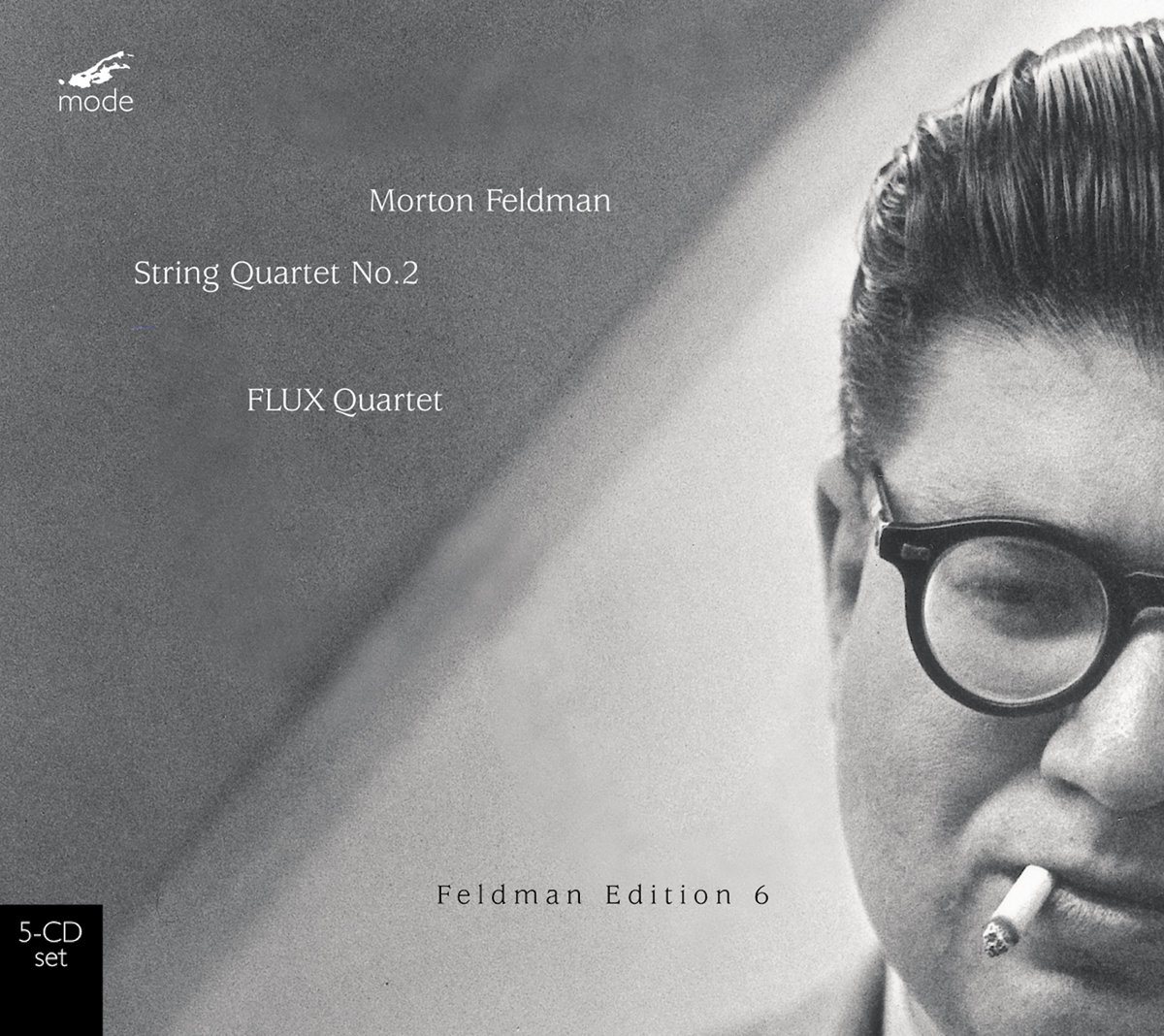
Mode's release of that undertaking, recorded in 2001, is the sixth instalment of its ongoing Feldman Edition: five discs, or a single audio DVD, of a work built entirely from long tones, quiet dynamics and a harmonic language with the tonal certainties filed off. Christian Wolff, who knew Feldman well enough to argue with him, contributes the liner notes, alongside Chiu's own account of what the piece asks of a player's arms and attention.
Feldman's notation is part of the point. He drew grids that fixed the number of attacks in a bar without fixing which pitches fell where, so performers were reading precise instructions that still left room to drift — a discipline built for imprecision.
Feldman spent the 1950s in rooms with John Cage, and looked, by his own account, more often at Rothko and Guston than at other composers' scores.
That is the right context for this quartet. It behaves like a very large abstract painting: no melody to follow home, no argument to resolve, just colour and duration doing the entire job. Feldman was open about the difficulty of asking anyone to sit through the whole thing — he used to say listeners could get up for a coffee and come back without missing anything essential — and the joke lands because it is true and also beside the point. The quartet was written in 1983 for the CBC, one year before his mammoth Guston tribute and two years before his own two-hour Violin and String Quartet, and it remains the longest thing he wrote. FLUX's recording is the version to hear it settle.