It takes Morton Feldman about eighty minutes to do something his own music spent forty years refusing to do: arrive at an ending that actually sounds like one.
Composed in 1985, the year he turned fifty-nine, Piano and String Quartet was commissioned jointly by the Kronos Quartet and the pianist Aki Takahashi for that year's New Music America festival, then in its seventh edition. Takahashi and the quartet — David Harrington, John Sherba, Hank Dutt and Joan Jeanrenaud — gave the premiere on 2 November 1985 at the Leo S. Bing Theater in Los Angeles, in a performance that ran sixty-eight and a half minutes; most groups since have taken closer to ninety.
He wrote the whole score out by hand, as he always did by that stage of his life, rather than sketching at the keyboard.
The score runs to 810 bars and treats piano and quartet as two entities that barely acknowledge each other. The strings hold long, quiet chords while the piano plays soft arpeggios against them, the pedal held down throughout so each chord keeps ringing under the next; about fifty minutes in, the strings start plucking instead of bowing, the one clear structural event in an hour and a half built almost entirely out of chords appearing to just barely change.
This is late-period Feldman, the decade in which duration itself became his subject rather than colour: pieces from the late 1970s onward stretch far beyond concert-hall norms not for shock value but because, as he found, only real duration lets a listener stop tracking incident and start tracking memory — how far back can you still hear the first chord from.
He had two years left to live.
This is Feldman's late testament, and it sounds like one. It has an actual architecture — statement, development, drift into pizzicato, close — of a kind he spent thirty years training listeners out of expecting from him, and it closes with a sense of finality more familiar from Mahler or Bruckner than from the composer of Rothko Chapel.
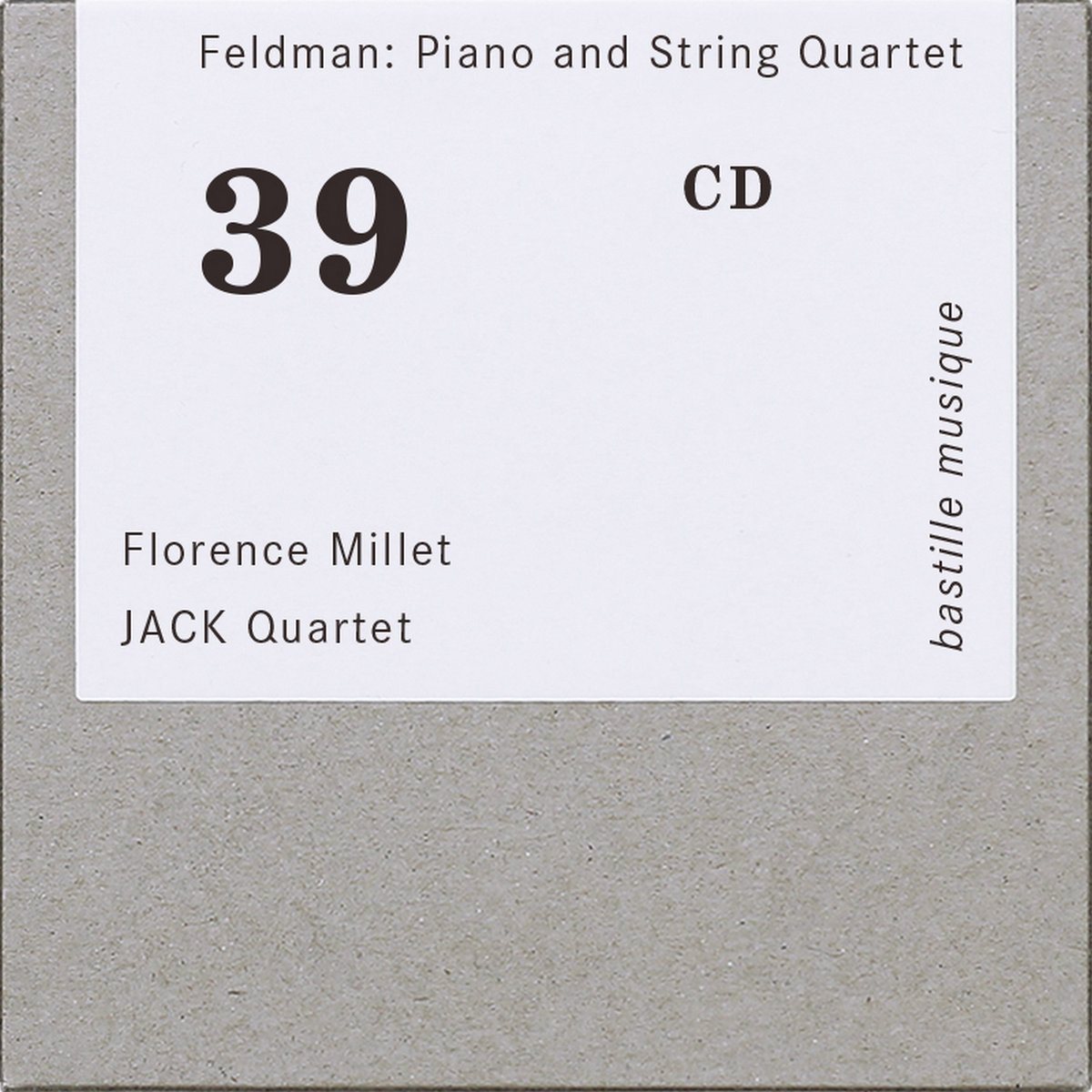
A new account of it comes from bastille musique, the Berlin label's thirty-ninth release: pianist Florence Millet and the JACK Quartet, recorded with West German Radio at the Immanuelskirche in Wuppertal and issued on 30 January 2026 with a hefty bilingual booklet, texts by Michael Struck-Schloen and photographs from the sessions tucked into a concertina fold.
JACK have built a reputation on repertoire built for extremes — Xenakis, Ligeti, the far edges of the string quartet literature — and their reading treats the piece's long tones with the same patience Kronos brought to it four decades ago, without trying to sound like anyone's memory of that older recording.