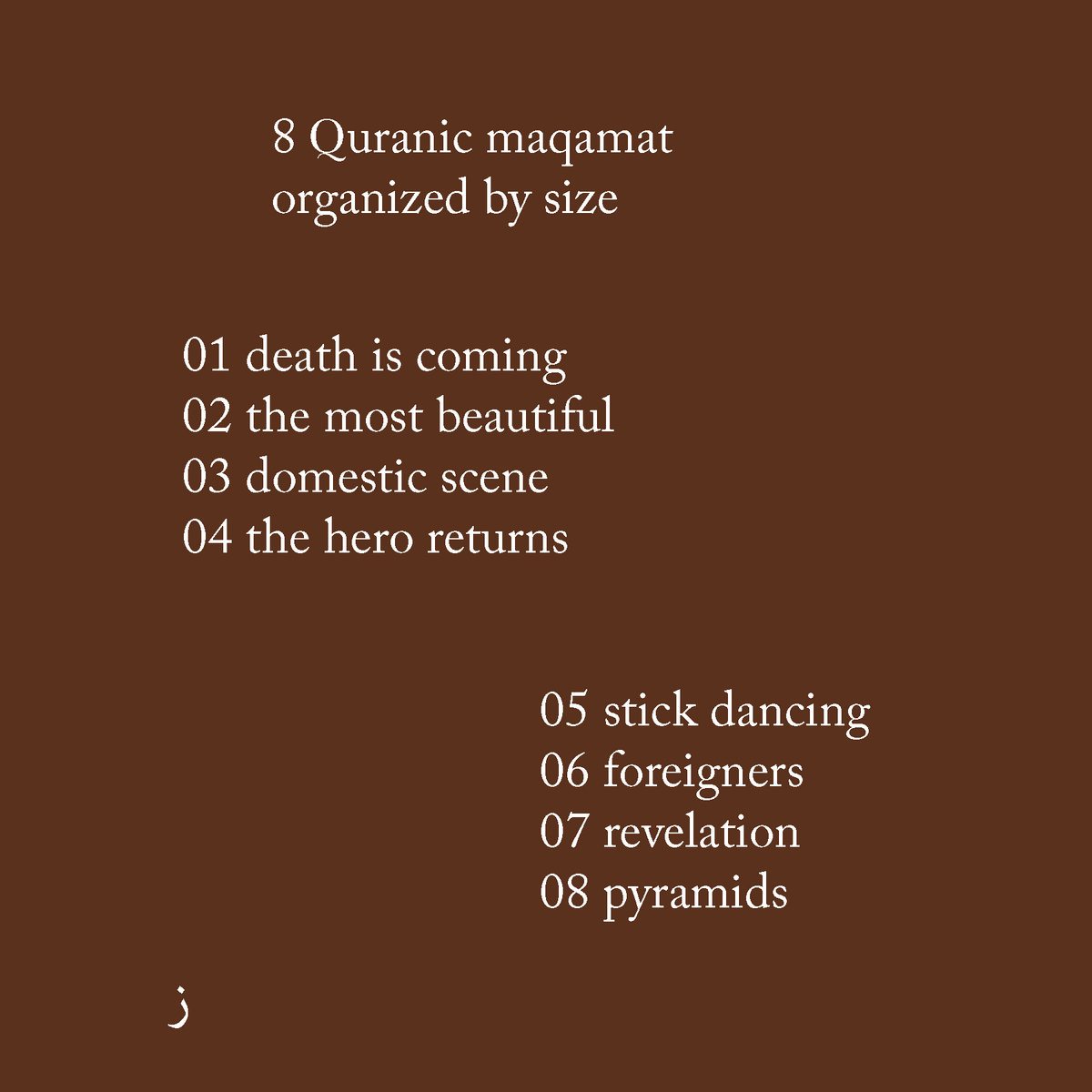
Zekkereya El-magharbel spent much of their childhood tuning Arabic music out. Growing up in Los Angeles in an Egyptian household that also played Satie, Tchaikovsky and Ravel, they gravitated toward the European canon and let the maqam recordings pass them by. 8 Quranic maqamat organized by size, the trombonist's 2023 solo record, is the sound of that decision being reversed, track by track.
The album sets eight solo trombone pieces against the seven-note maqamat system used in Quranic recitation, one theme per track, arranged not by mood or key but by size — the melodic range each maqam covers, smallest to largest. It is a curator's logic applied to devotional material, and it turns what could be an academic exercise into something closer to architecture: “Death is coming” opens the record, “Pyramids” closes it.
The choice of instrument is the argument.
El-magharbel plays trombone because its slide does what a fretted or keyed instrument cannot — it glides through the microtones and quarter-steps that Western notation was never built to hold, the same untempered space they find in the Sufi recitations of Ahmad Barrayn and Yasin Al-Tuhami, which they cite as models. They've also noted the instrument's own religious pedigree in Europe, where brass once carried church liturgy, and its vocal-adjacent timbre, which they say mirrors how maqam has always travelled — voice to voice, teacher to student, rarely written down.
That lineage runs both ways. A CalArts graduate and decade-long member of the Pan Afrikan Peoples Arkestra in Los Angeles, El-magharbel has studied with Angel Bat Dawid, Tyshawn Sorey, Steve Lehman and George Lewis — a cohort known for using notated and improvised music to interrogate its own history. The album's closing track makes a similar move explicit, framed as a tribute to Black Quantum Futurism and to the Black American musical foundation El-magharbel names as formative alongside Egyptian and Islamic tradition, rather than treating the two as inheritances to reconcile.
El-magharbel has said that pursuing a tradition doesn't have to be a quest for authenticity, which is a useful way to hear a record this exacting: less a return to something lost than a claim staked in real time. “After years of being in cultural paralysis,” they've written, “I claim the sonic future that I am meant to.” Alongside 8 Quranic maqamat, their catalogue includes Daytimes / Nighttimes, built from trombone and an SP-404 sampler, and Cairo Sessions — evidence of an artist treating heritage as raw material rather than subject matter.