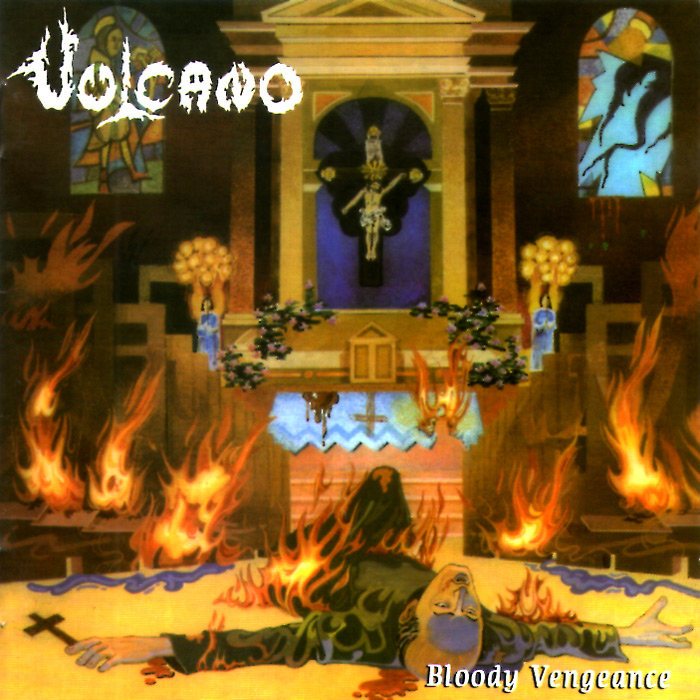
Bloody Vengeance sounds as if the recording equipment is struggling to survive the band. That is not a defect to explain away. Vulcano's 1986 debut makes scarcity audible: guitars blur at the edges, drums arrive with blunt physical force, and Angel's vocals seem to tear through a mix already operating at capacity.
The record came from Santos, the Brazilian port city where Vulcano had been working since 1981. By the time they recorded Bloody Vengeance, they had already released the 1985 live album Live!, an unusual route into a first studio LP. Founder Zhema Rodero has described the early Brazilian metal infrastructure as precarious: inadequate instruments and amplifiers, few suitable studios and little specialist engineering knowledge. Instead of hiding those limitations, Vulcano built an aesthetic from them.
The 1986 line-up was Angel on vocals, Rodero on bass, Soto Junior and Flavio on guitars, and Laudior Piloni on drums. The album was released on 10 August. Its eight songs include Dominios of Death, Spirits of Evil and the compact Ready to Explode, titles that make the band's anti-religious theatre explicit before a note is played.
But the interesting part is what happens beneath the imagery. The categories now used to organise extreme metal were still unstable, and Vulcano exploit that instability. Thrash provides the forward motion, yet the guitars often dissolve into a dirtier texture associated with first-wave black metal, while the low-end physicality points towards death metal. The music does not sound like a careful synthesis. It sounds like several new languages arriving at once.
That places Vulcano inside a particularly fertile Brazilian moment without making them interchangeable with it. Sepultura emerged from Belo Horizonte; Sarcófago pushed their own abrasive extremity. Vulcano's identity is tied instead to Santos and to Rodero's persistence. He remains the band's central figure in 2026, four and a half decades after its formation.
The debut's brevity is crucial. There is little room for technique to become spectacle. Riffs appear, establish their threat and are replaced by the next attack. Even when the playing becomes chaotic, the songs retain a grim economy. The effect is less about speed for its own sake than pressure.
That pressure is why Bloody Vengeance still matters. Plenty of extreme records can be made to sound old by production fashion. Vulcano's debut is harder to domesticate because its limitations and ambitions are inseparable. It documents musicians in Santos working with what they had and pushing it until the machinery itself seems implicated.