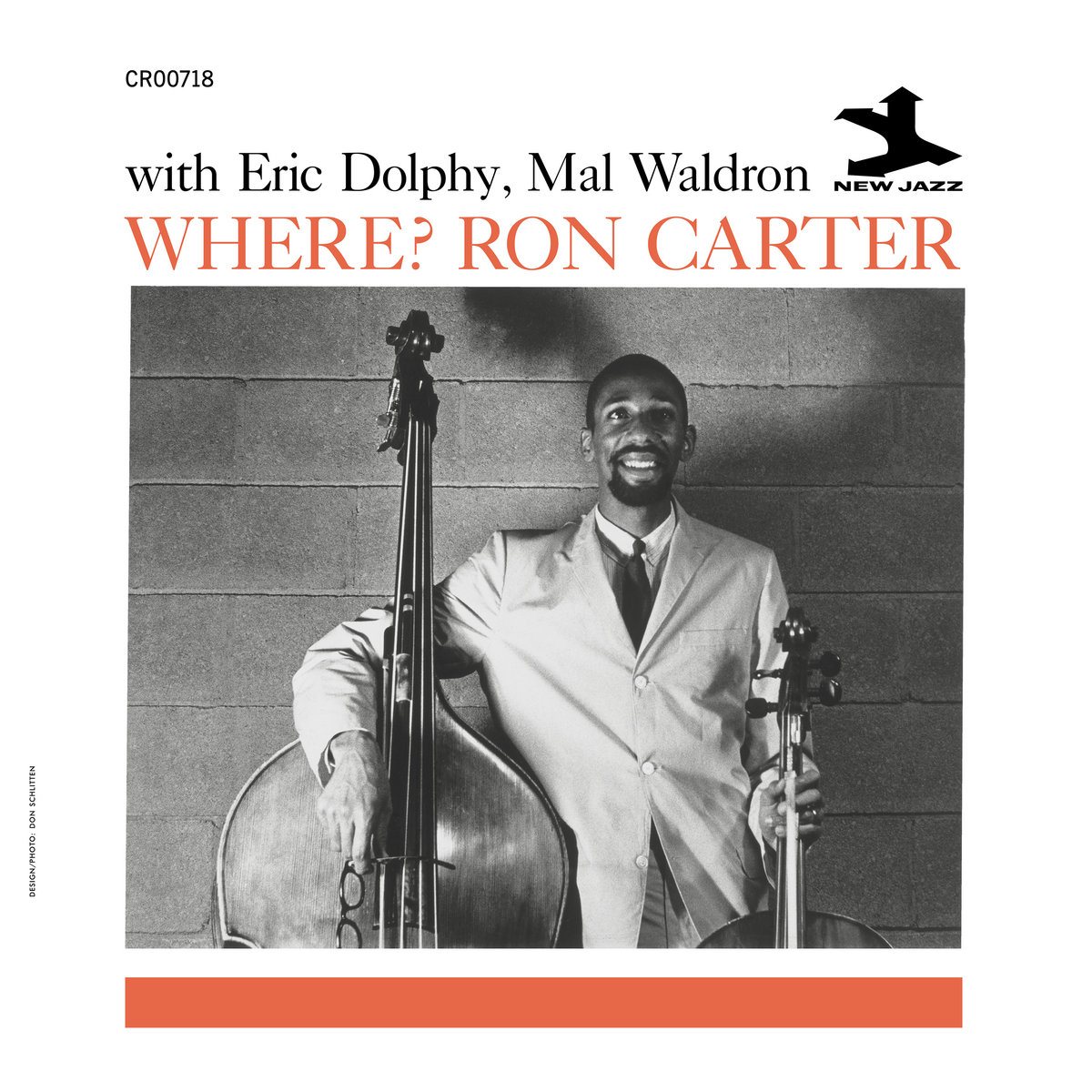
Ron Carter's first album as a leader isn't really about Ron Carter.
Recorded in a single session at Rudy Van Gelder's studio in Englewood Cliffs, New Jersey, on 20 June 1961, Where? finds the young bassist sharing his own date so generously that the record's most compelling voice belongs to someone else. Eric Dolphy moves between bass clarinet, alto saxophone and flute across the album's six tracks, treating each instrument as a separate argument rather than a doubling exercise, and the effect is of a leader who built his own showcase around somebody else's restlessness.
Carter had reason to defer. He'd arrived in New York only two years earlier and had already worked alongside Dolphy in Chico Hamilton's group, whose blend of chamber instrumentation and jazz phrasing sat close to what critics of the period were filing under third stream, music assembled from equal parts jazz and classical vocabulary. Where? sits in that same territory. Carter plays cello as well as bass, and on 'Bass Duet' he's joined by a second bassist, George Duvivier, treating the instrument as a duetting voice rather than a rhythmic floor. Mal Waldron's piano is spare and unshowy, closer to a third conversationalist than an accompanist, while drummer Charlie Persip is the one player keeping the session tethered to something closer to straightforward swing.
The material splits evenly between Carter's own writing, 'Rally' and 'Bass Duet', and outside material: two compositions by Randy Weston, including the title track, Sy Oliver's 'Yes, Indeed', and the standard 'Softly, As in a Morning Sunrise'. It reads like a young musician testing what his instrument could carry across very different rooms, from swing-era song to something closer to notated chamber writing.
Dolphy dominates all the same.
Carter later put the debt to him plainly: 'My main influence from Eric Dolphy was his dedication to practice: he was always playing somewhere, even with the birds in his backyard.' It's a strange, useful image for a record that sounds like practice made audible, five musicians working out how far a small group without a fixed centre of gravity could stretch before it stopped being a bass album and started being a conversation.
Where? was cut for New Jazz, Prestige's more adventurous subsidiary, produced by Esmond Edwards and issued the following year. Craft Recordings, the Los Angeles label now custodian of the Prestige catalogue, has returned to Van Gelder's original tapes for this remaster, released as part of its Original Jazz Classics series. Nothing has been added or reinterpreted. The point is simply to let a debut this quietly generous be heard at full resolution, more than six decades after a young bassist decided the best way to lead a session was to get out of its way.