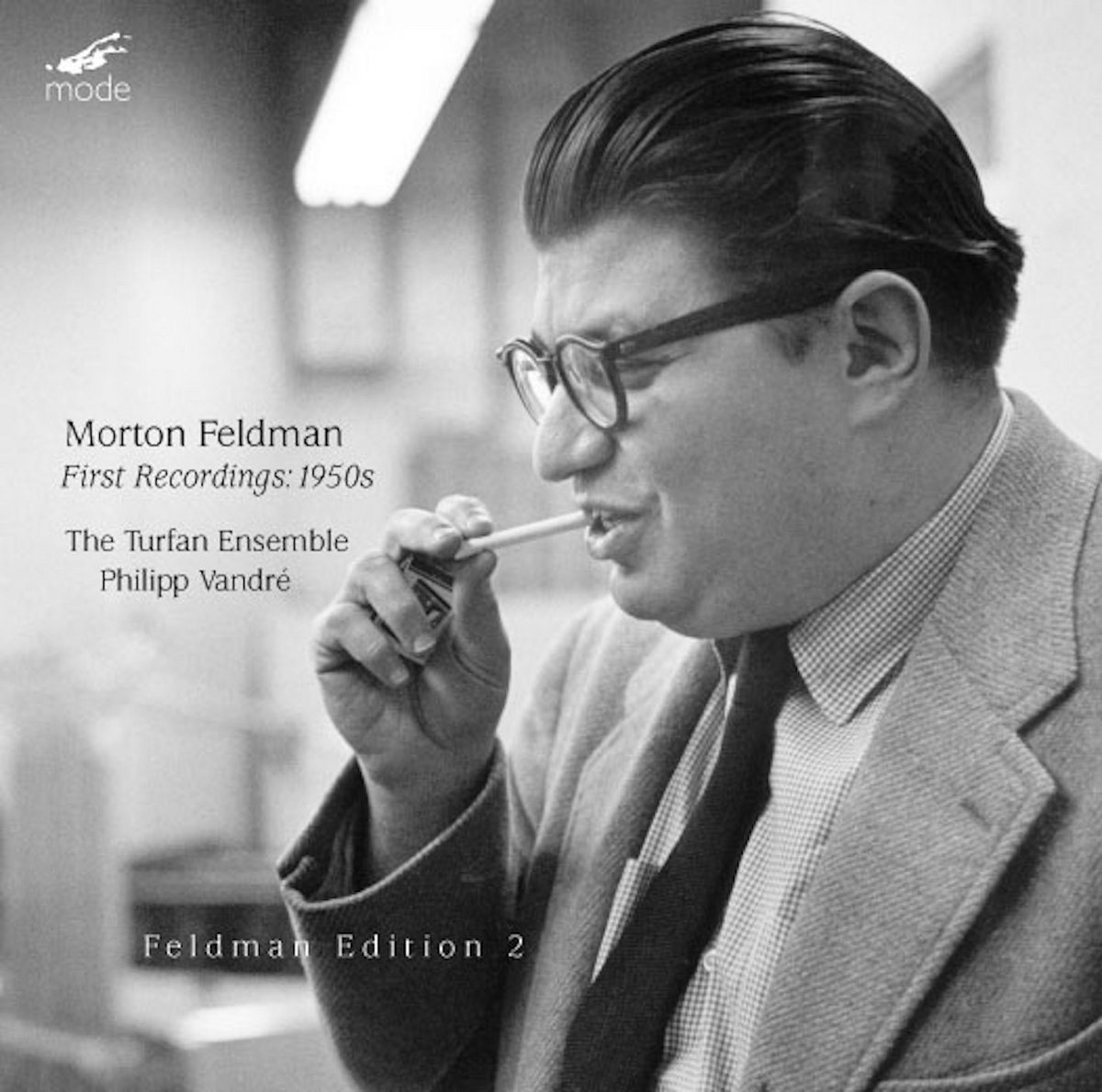
The strangest item in Morton Feldman's catalogue is a piece that was never written down and, for decades, existed nowhere at all. Intersection, made in 1953 with John Cage and Earle Brown, is the only tape work Feldman ever completed, an eight-channel composition built directly onto magnetic reels rather than a score, long assumed lost before its restoration turned up on Feldman Edition 2: First Recordings, released by Mode Records in February 1999.
That the piece survived at all says something about how Feldman worked. He never treated the score as sacred in the way most of his conservatory-trained peers did.
Feldman was born in Woodside, Queens, on 12 January 1926, studied piano with Vera Maurina Press and composition with Wallingford Riegger and Stefan Wolpe, and might have stayed a minor figure in American music if not for a single evening in early 1950. Leaving a New York Philharmonic performance of Webern, disgusted alongside a stranger by the audience's contempt for the piece, he fell into conversation with John Cage. The two became close enough that Feldman moved into Cage's building, and the friendship pulled him into a circle that included Earle Brown, Christian Wolff, and, just as importantly, painters: Rothko, Guston, Pollock, Rauschenberg, and the poet Frank O'Hara.
Feldman's graph notation, grids that specify how many notes to play and roughly how loud without fixing pitch, reads like something borrowed directly from that world, a score behaving like a canvas rather than a set of instructions. The New York School composers he belonged to alongside Cage, Brown and Wolff are usually discussed as a single movement, but the recordings on this disc make the differences audible: where Cage handed control to chance operations, Feldman kept asking performers to use judgement, taste, an ear trained the way a painter's eye is trained.
Mode's First Recordings collects thirteen previously unrecorded pieces from 1950 to 1953, played by pianist Philipp Vandré with the Frankfurt-based Turfan Ensemble, and its other centrepiece is just as odd as the tape work: the complete score Feldman wrote for Hans Namuth's 1950-51 documentary on Jackson Pollock, scored for two cellos and running alongside Pollock's own narration. Elsewhere the disc is quieter and more recognisably Feldman-in-training, the Nature Pieces and Intermissions for solo piano already working in the hush and patience that would define his later, much longer scores.
None of this material was written to impress anyone; it was written by a man testing what a page could tell a performer to do. Hearing it collected on one record, close to half a century after most of it was made, makes the case that Feldman's real subject was never sound alone but the peculiar trust required to let someone else interpret an instruction as sparse as long, quiet, high.