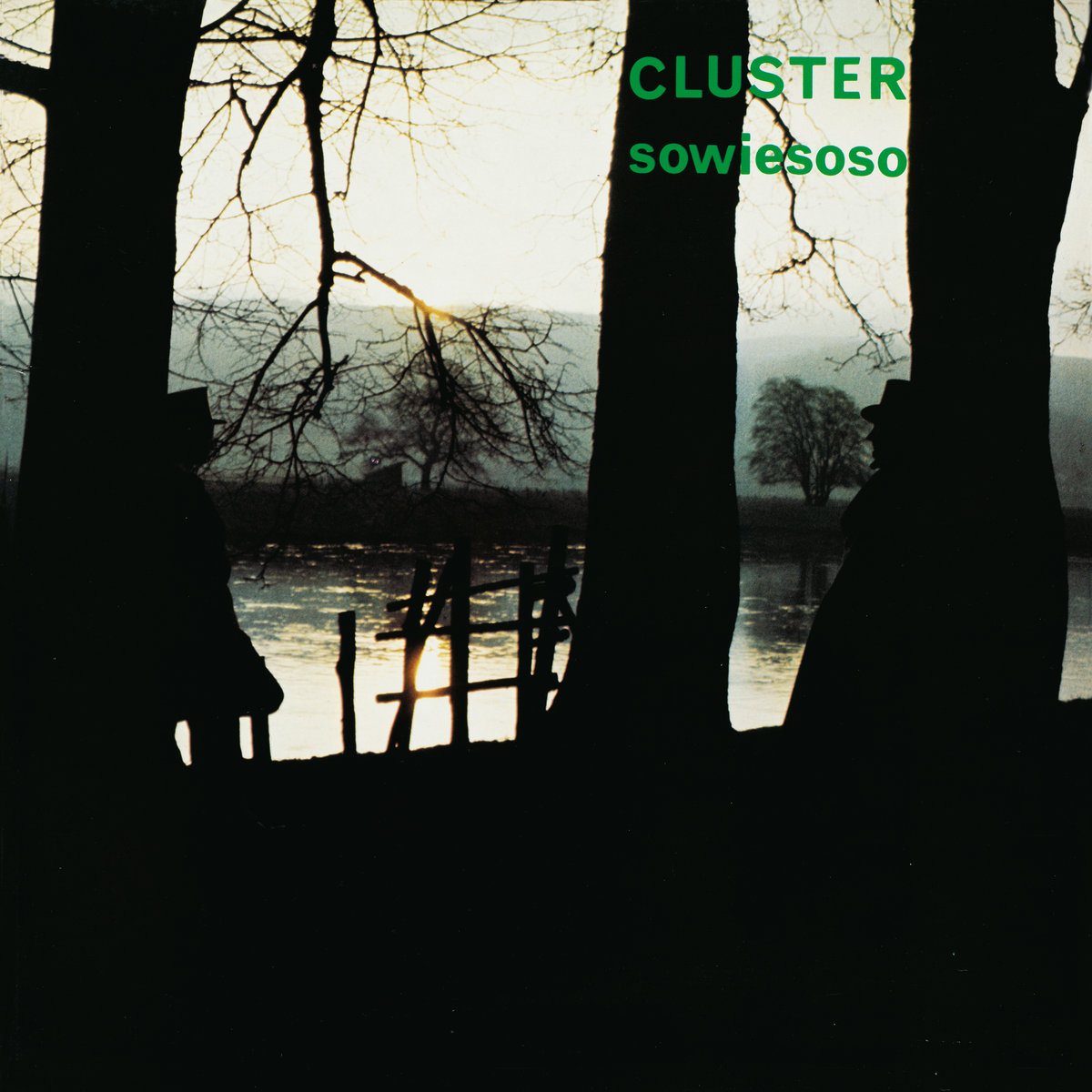
On Sowiesoso, the machines have stopped announcing themselves as machines. A rhythm box bubbles quietly. A piano enters without ceremony. Synthesizer tones chirp, wobble and drift past one another with the casual irregularity of things growing outside a window.
For Hans-Joachim Roedelius and Dieter Moebius, this is a striking distance from the raw electrical mass of early Cluster. By 1976, the duo are established in Forst, the rural Lower Saxony village where their music has acquired more air, melody and patience. Their work with Michael Rother in Harmonia has sharpened that transformation without erasing the eccentricity underneath it.
Sowiesoso was recorded in Forst in just two days and mixed at Conny Plank’s studio. Released on Sky Records in 1976, it contains seven jointly written pieces. The economy of the session suits the record: nothing sounds laboured, and few sounds appear merely to demonstrate what the equipment can do.
The title track establishes the grammar. A modest electronic pulse repeats beneath a lilting melody while small timbral changes keep shifting the light around it. “Halwa” brings a curling, arabesque-like phrase into the electronics; “Dem Wanderer” finds instability in a wavering string sound. On “Zum Wohl”, piano provides an unusually plain centre while synthesizers flicker around it like birds.
The piano is important. Cluster’s earlier records often transform sources until their identities become uncertain. Here an acoustic-seeming gesture can simply remain itself, giving the electronic sounds something tactile to push against. The contrast makes the technology feel warmer, not because the machines imitate nature but because they are allowed to coexist with imperfection.
Roedelius and Moebius are difficult to separate neatly into softness and abrasion. Their shared writing on Sowiesoso makes that division especially unhelpful. Melodic ease is repeatedly interrupted by odd timing, detuned colour or a rhythm that seems assembled from cheap domestic electronics. The beauty always has a loose screw somewhere.
That is why the album avoids the weightlessness that can come with pastoral electronic music. “In Ewigkeit”, the closing piece, stretches into a slower, more melancholy space, but a shadow of pulse remains underneath. Cluster never entirely surrender motion.
Sowiesoso does not need futurism. Its achievement is smaller and stranger: Roedelius and Moebius make electronic instruments sound ordinary enough to belong in a room, beside a piano, with the countryside outside.
The technology disappears. The personality does not.