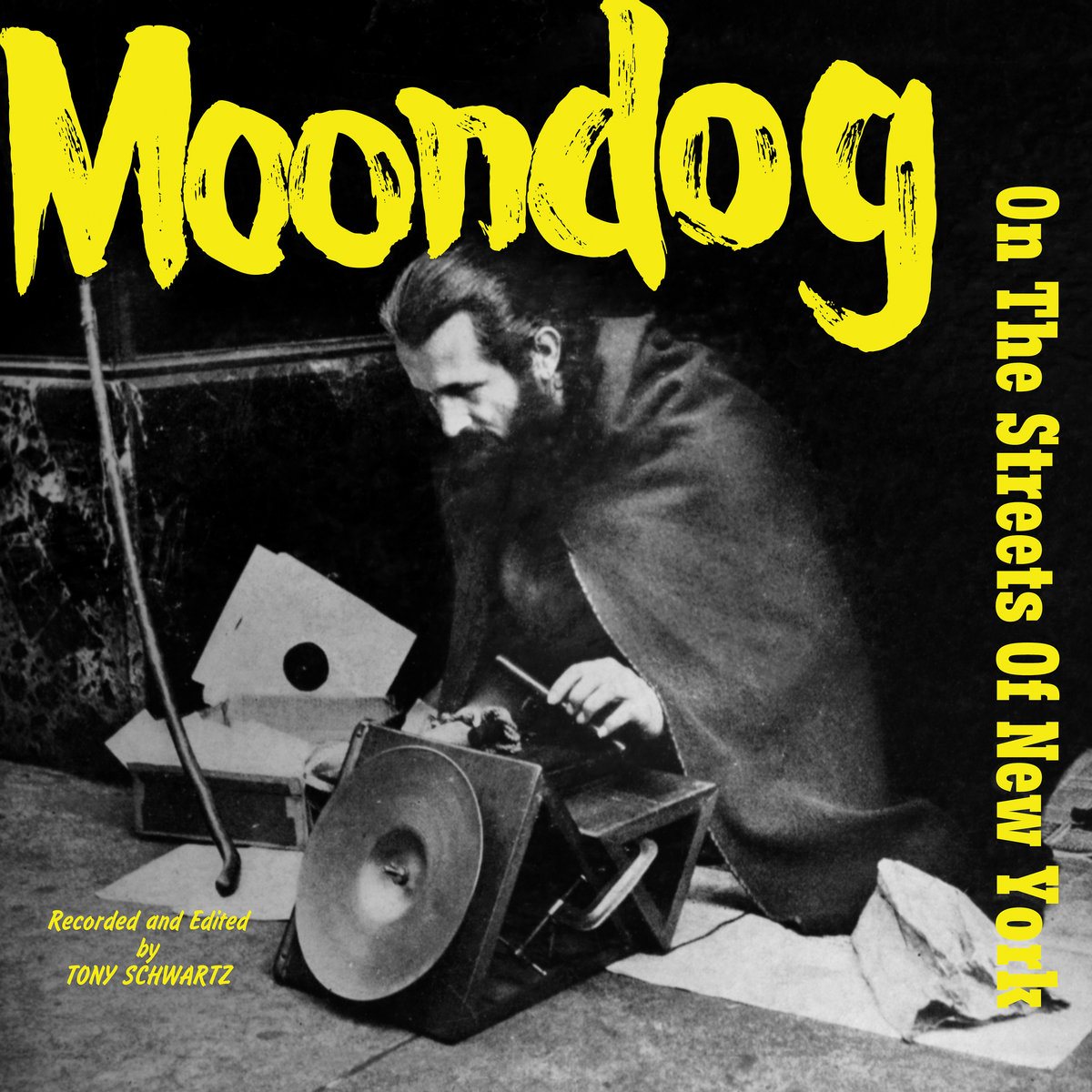
The titles give the game away. Avenue of the Americas (51st Street). 2 W 46th Street. Fog on the Hudson. These are not song names so much as coordinates, and that is the right way to hear On The Streets of New York, a set of twenty-one short recordings released digitally in April 2020 from the estate of Moondog and the Tony Schwartz collection at the Library of Congress. Most pieces run under two minutes. Three are labelled percussion solos in traffic, and the traffic is part of the take.
Louis Thomas Hardin was born in Kansas in 1916 and lost his sight at sixteen, when an explosive he picked up in a field went off in his face. He arrived in New York in 1943, took the name Moondog by 1947 in honour of a dog that howled at the moon, and for the next quarter century worked the stretch of Sixth Avenue between 52nd and 55th Streets, selling records and poems, playing instruments of his own design. The trimba, a triangular drum, and the oo, a small harp, both turn up here. He called his rhythmic language snaketime, slithery metres in times that are not ordinary, and on a piece like On and Off The Beat you can hear the idea before you can count it.
Tony Schwartz was the man with the tape recorder. A sound archivist who produced the WNYC programme Around New York from 1945 to 1976 and released a run of Folkways albums about the city, he had already put Moondog on record in 1954. What survives on this album is the raw material: chants sung in a low, unhurried voice, drum figures that lock and then slip, a three-part Nocturne Suite that stretches out to nearly nine minutes and shows the composer behind the curiosity. The Lullaby at 2 W 46th Street is exactly that, a small tune played somewhere a lullaby has no business being.
The curiosity was real. He wore a homemade Viking costume and a horned helmet, and in 1954 he won a case in the New York State Supreme Court against the disc jockey Alan Freed, who had borrowed the name for his rock and roll show. The studio career that followed suggests the sidewalk was a choice, not a limit: two Prestige albums in 1956, a children's record with Julie Andrews in 1957, then the Columbia LPs of 1969 and 1971 with full orchestra. Big Brother and the Holding Company covered his All Is Loneliness in 1967, and Philip Glass has described the early street work as a major influence on his generation of New York composers.
Moondog left for Germany in 1974, was taken in by a young student named Ilona Goebel in Oer-Erkenschwick, and spent his last years in Münster, where he died in 1999, five years after recording Sax Pax for a Sax with the London Saxophonic. None of that late polish is on this record. It is a man, a drum, a corner, and a city that would not stop for him and did not need to.